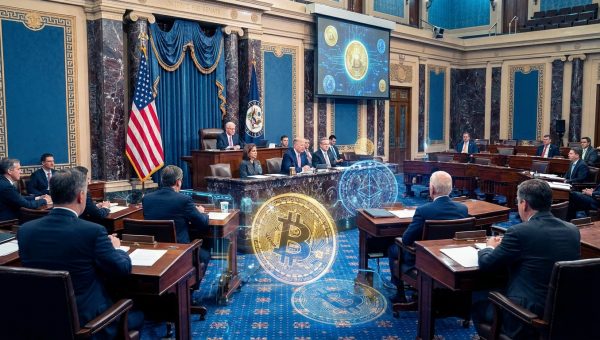

SEC and CFTC Sign Historic MOU: America Finally Has a Unified Crypto Regulatory Framework
For the first time in the history of U.S. financial regulation, the Securities and Exchange Commission and the Commodity Futures Trading Commission have signed a formal Memorandum of Understanding committing both agencies to a coordinated, fit-for-purpose regulatory framework for crypto assets.
The MOU, signed on March 11, 2026, followed a joint crypto asset guidance release days earlier in which both agencies simultaneously clarified how existing federal securities and commodities laws apply to digital assets — ending years of contradictory enforcement actions, conflicting guidance, and regulatory uncertainty that had driven billions in crypto capital offshore.
This is not incremental progress. This is a structural shift in how America governs digital assets.
What the MOU Actually Commits Both Agencies To
The Memorandum of Understanding between SEC Chairman Paul Atkins and CFTC Chairman Michael Selig establishes a framework for:
- Coordinated jurisdiction: A shared understanding of which types of crypto assets fall under SEC oversight (securities) versus CFTC oversight (commodities/futures), reducing the legal ambiguity that has plagued token issuers for years
- Joint regulatory framework: Commitments to develop fit-for-purpose rules specifically for crypto assets, rather than forcing digital assets into frameworks designed for stocks and derivatives
- Streamlined regulatory reporting: Unified standards for trade data, fund reporting, and intermediary oversight across both agencies
- Cross-market examinations: Coordinated surveillance, risk monitoring, and enforcement actions to prevent regulatory arbitrage
- Economic analysis coordination: Joint research on crypto market structure to inform rules grounded in evidence rather than assumption
CFTC Chairman Selig called it a landmark moment: “For far too long, American builders, innovators, and entrepreneurs have awaited clear guidance on the status of crypto assets under the federal securities and commodity laws. With today’s interpretation, the wait is over.”
SEC Chairman Atkins echoed the tone, noting that the joint framework reflects a commitment to “fostering a regulatory environment that allows the crypto industry to flourish in the United States with clear and rational rules of the road.”
Why This Matters So Much
To understand the significance of this MOU, consider the previous decade of U.S. crypto regulation — or rather, the absence of it.
The SEC, under former Chairman Gary Gensler, pursued an aggressive enforcement-first strategy, filing lawsuits against Coinbase, Binance, Ripple, Kraken, and dozens of other crypto entities while simultaneously refusing to provide clear guidance on which tokens were securities. The result was legal chaos: companies couldn’t build compliance programs against rules that didn’t exist in written form.
The CFTC, meanwhile, had clearly defined authority over Bitcoin and Ethereum futures but limited jurisdiction over spot markets. Attempts by Congress to clarify the agencies’ respective turf had repeatedly stalled.
The March 2026 joint guidance and MOU represent the first time both agencies have spoken with one voice — and the first time the message has been explicitly pro-clarity rather than enforcement-oriented.
The Joint Crypto Asset Guidance: Key Points
Released alongside the MOU, the joint SEC-CFTC guidance established several major principles:
Most major crypto assets are commodities, not securities. Bitcoin, Ethereum, and most proof-of-work and proof-of-stake assets with sufficiently decentralized governance fall under CFTC jurisdiction, not the SEC’s securities regime. This resolves the most contentious classification battles of the past decade.
Airdrops, staking, and wrapping have defined treatment. The SEC separately issued explicit guidance (referenced in recent CryptoGazette coverage) clarifying that staking rewards are not automatically securities, airdrops are generally not securities offerings, and wrapped tokens are not separate securities from their underlying assets.
Issuance frameworks: Tokens sold in initial offerings to raise capital may still require registration or exemption — but the guidance provides clearer bright-line tests for when that applies.
What Changes for the Crypto Industry
The practical effects are already rippling through the market:
Institutional onboarding accelerates. Major banks, asset managers, and broker-dealers that had deferred crypto product launches due to regulatory uncertainty now have a clearer compliance roadmap. Fidelity, BlackRock, and JPMorgan have all signaled expanded crypto offerings for 2026.
Offshore capital may return. Billions in crypto business activity — exchanges, token issuers, DeFi teams — relocated to Dubai, Singapore, Switzerland, and Cayman during the enforcement era. Clearer U.S. rules reduce one of the primary incentives for that exodus.
DeFi still has questions. The MOU and guidance are largely silent on decentralized protocols. The CLARITY Act, currently moving through Congress, is expected to address DeFi specifically — but until it passes, DeFi operators face continued ambiguity.
Enforcement scope narrows. Both agencies have signaled that the era of aggressive enforcement-by-litigation against companies operating in good faith is over. Future enforcement actions are expected to target clear fraud and manipulation rather than regulatory ambiguity disputes.
The Global Context
The timing of the U.S. moves is notable: the EU’s MiCA framework (Markets in Crypto-Assets) became fully effective in late 2024, establishing a comprehensive EU-wide licensing regime. The UK’s Financial Conduct Authority finalized its crypto asset framework in early 2026. Dubai’s VARA (Virtual Assets Regulatory Authority) has been operational since 2022.
The U.S. was the last major financial jurisdiction without a coherent crypto framework. The SEC-CFTC MOU and the pending CLARITY Act represent America catching up — and potentially reasserting its position as the world’s premier crypto capital market.
FAQ
Q: What is the SEC-CFTC MOU and what does it do?
The Memorandum of Understanding signed on March 11, 2026, commits the SEC and CFTC to coordinate their oversight of crypto assets, share surveillance and enforcement resources, and develop a unified, fit-for-purpose regulatory framework for digital assets. It ends years of jurisdictional confusion between the two agencies.
Q: Does the SEC-CFTC MOU mean all crypto assets are now legal in the U.S.?
Not automatically. The MOU provides a framework for clarity, not blanket legalization. Most established crypto assets (Bitcoin, Ethereum, and many others) now have clearer commodity status under CFTC oversight. Assets that are securities still require SEC registration or exemption, though the guidance provides clearer criteria for that determination.
Q: How does this relate to the CLARITY Act?
The SEC-CFTC MOU and joint guidance represent executive agency-level coordination. The CLARITY Act is a Congressional bill that, if passed, would enshrine these distinctions into law and provide more comprehensive market structure rules, including for DeFi and stablecoin issuers. The MOU advances the same goals through regulatory rather than legislative action.
Sources: SEC.gov press release (March 11, 2026), CFTC joint guidance (March 17, 2026), The Block, Congress.gov, DL News, Blockchain Association.