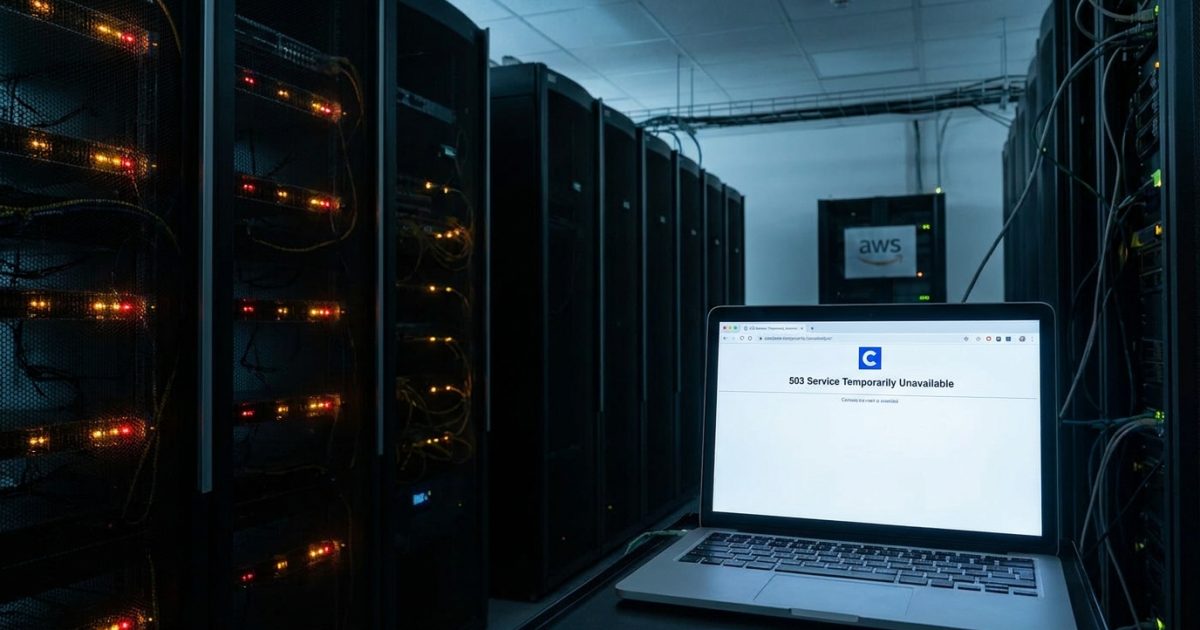
Coinbase, the largest US crypto exchange, suffered a five-hour outage on May 8, 2026, after an Amazon Web Services data center in the US-East-1 region experienced a thermal failure. Millions of users were locked out of their accounts during a period of heightened market activity, unable to trade, view balances, or access their portfolios. The exchange said funds were safe throughout the incident.
The outage is the most prominent cloud infrastructure failure to hit the crypto industry this year and has renewed questions about centralized exchanges’ dependency on third-party cloud providers.
What Happened
The incident began when a single-zone thermal event in AWS’s US-East-1 region — the company’s largest and oldest cloud region, based in Northern Virginia — caused cascading service degradation across multiple major platforms. Coinbase was among the highest-profile customers affected, along with FanDuel and CME Group.
Coinbase’s status page flagged the issue as “degraded performance due to an AWS outage” within the first hour. As the situation progressed, it became clear that critical trading infrastructure, not just peripheral services, had been affected. Order routing, account authentication, and portfolio display all showed failures.
By hour three, Coinbase had posted a message confirming the outage’s root cause and assuring customers that their funds remained secure in cold and hot storage unaffected by the cloud disruption.
The exchange issued an all-clear approximately five hours after the incident began, saying services had been fully restored and that a complete post-mortem investigation would follow.
Why It Landed Badly
The timing compounded the reputational damage. Coinbase had recently announced layoffs and reported Q1 losses, and the exchange was already under scrutiny over its decision to settle a data breach disclosure case with the SEC. An infrastructure failure of this length, at this scale, brought criticism from across the industry.
Some critics questioned why Coinbase, which manages billions of dollars in client assets and positions itself as an institutional-grade platform, does not operate its own redundant infrastructure independent of a single cloud provider. Exchanges in traditional finance, including CME Group, run distributed infrastructure specifically to avoid single points of failure.
Others pointed out that the crypto industry broadly — including Coinbase, Kraken, and Binance — relies heavily on AWS and Google Cloud. A major regional AWS failure, particularly in US-East-1, has the potential to take down significant portions of the crypto trading infrastructure simultaneously.
What Coinbase Said
In a statement following the incident, Coinbase said it was committed to improving its infrastructure resilience. The company did not immediately commit to reducing its AWS dependency but said the full post-mortem would address infrastructure architecture.
CEO Brian Armstrong did not comment publicly on the outage. The exchange’s communications team handled messaging through official channels, emphasizing fund safety throughout.
Coinbase’s status page, which is managed independently of its primary infrastructure, remained accessible throughout the incident — a fact the company cited as evidence that its monitoring and transparency protocols functioned correctly.
Broader Infrastructure Questions
The incident is part of a recurring pattern that the crypto industry has struggled to address. Cloud concentration risk has been flagged by security researchers and regulators alike.
In traditional finance, exchanges and clearinghouses operate under strict continuity requirements that include geographically distributed backups, mandatory failover testing, and minimum uptime standards. Crypto exchanges, even publicly listed ones like Coinbase, are not subject to equivalent requirements.
As the CLARITY Act advances through Congress, some regulatory analysts have noted that exchange infrastructure standards could become part of the final legislation or future rulemaking. The Coinbase outage will likely be cited in those discussions.
For retail users, the five-hour blackout was a reminder that even the most established crypto platforms carry infrastructure risks that are not always visible during normal operating conditions. Diversifying across platforms and using non-custodial options for long-term holdings are standard recommendations that circulated widely in the aftermath.
What the Market Saw
The outage coincided with a period when Bitcoin was trading under pressure. Users who attempted to trade during the downtime faced two risks simultaneously: falling prices and an inaccessible platform. Some noted on social media that they were unable to execute stop-losses, adding to losses that a functioning platform might have mitigated.
The incident has reignited debate about whether decentralized exchanges, which run on smart contract infrastructure rather than centralized servers, offer a genuine alternative for users who want trading access that is not dependent on any single operator’s uptime.
Decentralized exchange volume did spike modestly during the Coinbase outage, suggesting some users attempted to route around the disruption using on-chain alternatives.
FAQ
Why did Coinbase go down for five hours?
An AWS data center in the US-East-1 region experienced a thermal failure, which disrupted cloud services across multiple major platforms, including Coinbase. The exchange’s trading and account infrastructure depends on AWS cloud services.
Were Coinbase user funds at risk?
No. Coinbase confirmed throughout the outage that customer funds were safe. The disruption affected access and trading functionality, not custody of assets.
What can Coinbase do to prevent future outages?
Options include building geographically distributed infrastructure across multiple cloud providers, operating proprietary data centers for critical trading systems, and implementing faster failover mechanisms to minimize downtime during third-party cloud failures.
*Source: CoinDesk, cryptoticker.io, CCN, SingleStore blog, Coinbase status page*