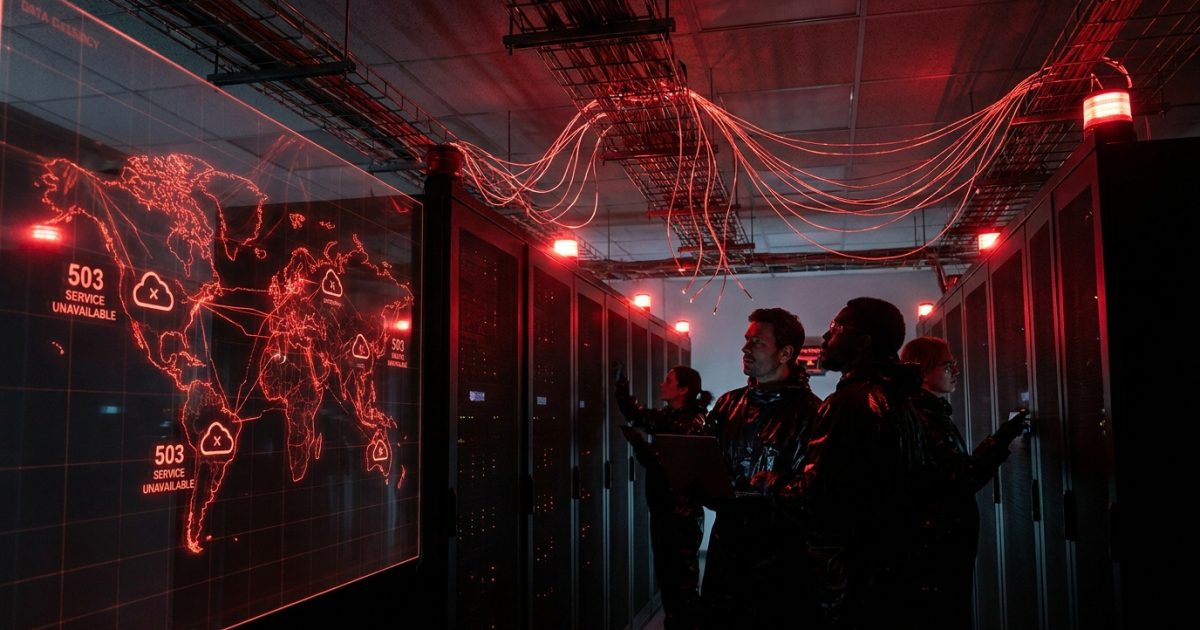

Coinbase, the largest publicly listed cryptocurrency exchange in the United States, went offline for approximately five hours on May 8, 2026, after a critical hardware failure at an Amazon Web Services data center in northern Virginia knocked out core trading infrastructure across multiple AWS availability zones. Millions of users were unable to execute trades, access account balances, or process withdrawals during what turned out to be one of the exchange’s longest unplanned outages since its 2021 IPO.
Coinbase CEO Brian Armstrong later posted on X that centralized cloud dependency causing exchange downtime was “never acceptable” – a pointed public statement given that Coinbase’s infrastructure runs almost entirely on AWS.
What Happened
The incident began in the early morning hours of May 8, triggered by a thermal failure at the AWS US-EAST-1 data center in Ashburn, Virginia. AWS’s US-EAST-1 region is one of the oldest and most heavily used cloud availability zones globally, hosting infrastructure for thousands of enterprise customers including financial services firms, government contractors, and media platforms.
When cooling systems at the Ashburn facility failed, AWS automatically began shedding load across multiple zones in the region as a protective measure. For Coinbase, which routes core trading services through US-EAST-1, the cascade resulted in what the exchange described in a public post as “failures in multiple AWS zones that caused an extended outage of core trading services.”
FanDuel, the sports betting platform, also reported disruptions traced to the same AWS failure, confirming the incident’s scope extended well beyond the crypto sector.
Five Hours Without Trading
From approximately 6:00 AM to 11:00 AM ET on May 8, Coinbase users found themselves unable to place buy or sell orders through the exchange’s web and mobile interfaces. The outage came during a period of heightened market activity – Bitcoin was trading near the $80,000 level and showing raised volatility following the previous week’s CPI data.
Users unable to trade during a volatile period faced potential losses from positions they couldn’t exit or hedge. Within hours, Coinbase’s X account had accumulated thousands of replies from traders expressing frustration – including several who claimed they missed time-sensitive liquidation defences.
Coinbase’s status page confirmed the issue within the first hour and issued updates approximately every 30 minutes until resolution. The exchange maintained throughout that customer funds were safe and that the outage affected execution only – not custody or balances.
By midday, Coinbase announced the primary issue had been fully resolved and trading services were restored. A full post-incident report was promised but hadn’t been published as of press time.
Armstrong’s “Never Acceptable” Statement
CEO Brian Armstrong’s public response drew significant commentary. His X post stated that exchange downtime caused by centralized infrastructure failures was “never acceptable” – language that crypto-native observers were quick to point out carries a degree of irony for a platform that built its trading infrastructure on a single major cloud provider.
Several DeFi advocates pointed to the incident as a practical illustration of the decentralization argument: protocols running on distributed blockchain infrastructure don’t have single points of failure that can be taken down by a Virginia data center overheating.
Armstrong didn’t announce any specific changes to Coinbase’s infrastructure strategy but indicated an investigation would follow.
Context: A Rough Period for Coinbase
The May 8 outage arrived at a difficult moment for the exchange. Coinbase posted a $12.54 billion loss in Q1 2026, primarily driven by unrealised losses on its Bitcoin holdings as BTC prices declined from late 2025 peaks. The company also announced staff layoffs during the quarter, drawing attention to cost management pressures.
The combination of a headline financial loss, layoffs, and a five-hour trading blackout across one of the most closely watched exchanges in crypto compressed into a short window – creating an unusually negative news cycle for a company that had spent much of the past two years positioning itself as the compliant, institutional-grade face of U.S. Crypto.
CoinDesk noted in its coverage that Armstrong’s “never acceptable” statement drew criticism given the circumstances, with some analysts questioning whether the public acknowledgment helped or highlighted the reputational damage.
What Centralised Exchanges Can Learn
The Coinbase incident renews a debate that surfaces every time a major centralised platform goes offline: the structural vulnerability of crypto exchanges that depend on traditional cloud infrastructure for uptime.
Several larger exchanges, including Binance and Kraken, operate across multi-region, multi-cloud architectures specifically to prevent single-zone failures from taking down trading. Industry observers have for years recommended that crypto exchanges – which deal in assets that trade 24/7 with no circuit breakers – should maintain stricter uptime standards than traditional stock exchanges, which can halt trading under extreme conditions.
AWS, for its part, has faced criticism in the past for the US-EAST-1 region’s disproportionate impact on internet-wide services when it experiences problems. Major outages in the region have caused cascading failures affecting Netflix, Reddit, and various financial services platforms at different points over the past several years.
FAQ
Were Coinbase user funds safe during the outage? Yes. Coinbase confirmed throughout the outage that customer funds remained fully safe and unaffected. The disruption was limited to order execution and account interface access – no funds were at risk of loss.
How long did the Coinbase outage last? The outage lasted approximately five hours, from roughly 6:00 AM to 11:00 AM ET on May 8, 2026. This makes it one of the exchange’s longest unplanned outages in recent years.
Why does Coinbase use AWS instead of its own infrastructure? Like most technology companies, Coinbase relies on major cloud providers for scalability, cost efficiency, and global reach. Building and operating owned data centers at Coinbase’s scale would require substantial capital investment and ongoing operational complexity. The trade-off – lower cost and faster scaling versus centralized failure risk – is a common one across the technology industry.
— *Sources: CoinDesk, CNBC, CryptoTicker, CoinFomania, Coinbase Status Page*