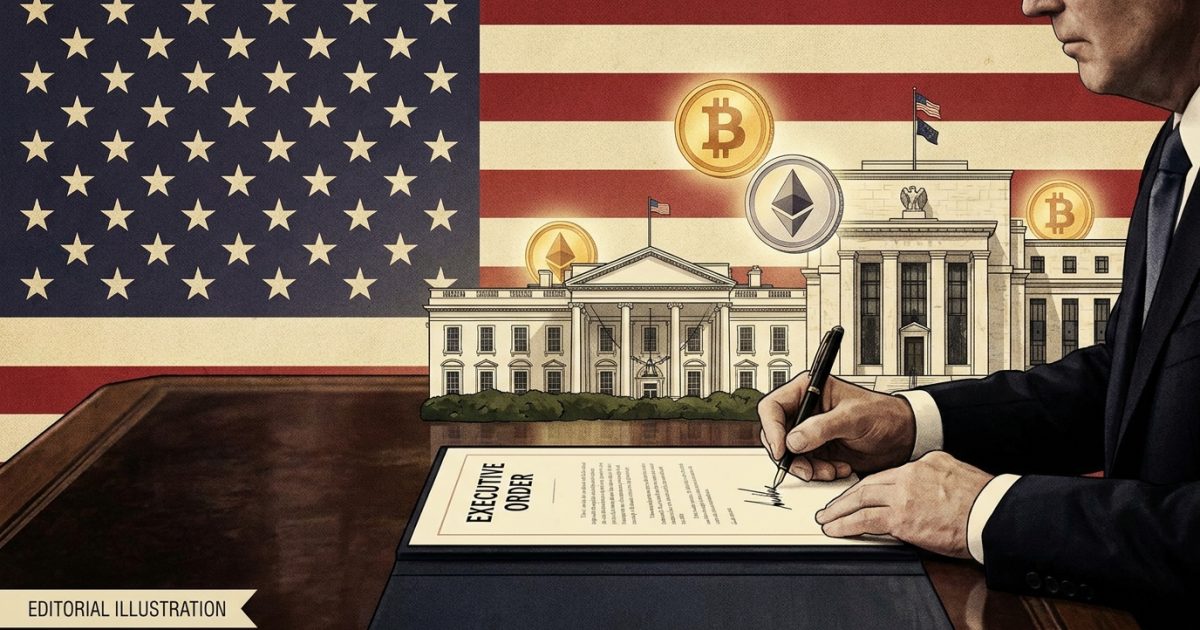

President Donald Trump signed an executive order this week that could fundamentally reshape how cryptocurrency companies interact with the U.S. Banking system – directing the Federal Reserve to evaluate whether non-bank firms, including crypto businesses, should gain direct access to Fed master accounts and payment services.
The order, signed on May 19-20, 2026, signals the most aggressive executive-level push yet to integrate digital asset firms into mainstream financial infrastructure.
What the Order Requires
The executive order gives the Federal Reserve 120 days to complete a formal review of its policies governing access to master accounts – the accounts that banks hold directly with the Fed, enabling participation in the U.S. Payment system.
Currently, crypto firms must operate through partner banks rather than holding master accounts directly. This indirect access creates friction, added costs, and dependency on banks that have historically been reluctant – or pressured – to serve the sector.
A separate provision in the order mandates that financial regulators update and simplify fintech-related rules within 90 days, and gives agencies three months to identify any regulations deemed “discriminatory” against cryptocurrency companies.
The End of Operation Choke Point 2.0?
Industry insiders are reading this order as a formal death knell for what critics have dubbed “Operation Choke Point 2.0” – a pattern of regulatory pressure that emerged under the Obama administration and was widely viewed as intensifying during the Biden years.
Under that system, federal banking supervisors allegedly pressured financial institutions to cut ties with crypto companies, firearms dealers, and other industries considered politically disfavored. Crypto firms bore the brunt of this, with several high-profile cases of account closures and denied banking relationships throughout 2022 and 2023.
“This is the clearest signal yet that the current administration views debanking as a policy problem, not just a talking point,” said one industry attorney who works with digital asset firms.
Fed Chair Warsh Expected to Cooperate
Kevin Warsh, expected to become the next Federal Reserve Chair, is widely anticipated to move in alignment with the order. Ian Katz, an analyst at Capital Alpha Partners, noted plainly: “We don’t expect that the order will be ignored.”
That assessment carries weight. The Fed’s independence on monetary policy is one thing – but its regulatory posture on account access has long been shaped by political and supervisory guidance. With a new administration setting the direction and a sympathetic Fed chair incoming, the conditions for real change are more credible than they have been at any point in the past decade.
DeFi Protocols Could See Indirect Benefits
The downstream implications extend beyond centralized exchanges and crypto custodians. DeFi protocols – which often require fiat on-ramps and off-ramps that depend on traditional banking rails – stand to benefit if crypto-native firms gain direct access to Fed settlement infrastructure.
Broader banking access would reduce the chokepoints where DeFi intersects with traditional finance, potentially enabling more competitive payment services and tighter integration with dollar-denominated settlement.
Analysts tracking the sector note that stablecoin issuers in particular could see significant operational improvements if master account access becomes available to licensed non-bank entities.
Industry Response
The reaction from the crypto industry has been cautiously optimistic. Trade groups and lobbyists who spent years pushing back against debanking practices see the order as both a validation of their arguments and a concrete policy mechanism – albeit one that still depends on regulatory follow-through.
“The 120-day clock matters,” said one policy consultant who has worked with multiple digital asset companies on banking access issues. “The question is what system the Fed establishes and whether it creates a meaningful pathway or a bureaucratic wall dressed up as reform.”
The order doesn’t guarantee that the Fed will approve master account applications from crypto firms. It requires a review – and potentially forces the Fed to articulate explicit criteria rather than operating through informal pressure and ad hoc denial decisions.
What Comes Next
The 90-day window for fintech rule simplifying runs concurrently with the Fed review. If regulators move quickly and transparently, the crypto industry could see meaningful banking access improvements before the end of 2026.
The three-month window to identify discriminatory regulations adds another dimension: agencies may be forced to either defend existing policies publicly or walk them back before they face formal scrutiny.
For crypto companies that have spent years navigating a hostile banking environment, the combination of these three timelines creates a window of genuine policy opportunity – one that advocacy groups are already working to influence before the reviews conclude.
Frequently Asked Questions
what’s a Federal Reserve master account, and why does it matter for crypto?
A Fed master account allows institutions to hold funds directly with the Federal Reserve and access the U.S. Payment settlement system without going through an intermediary bank. For crypto companies, gaining direct master account access would reduce dependency on partner banks, lower transaction costs, and eliminate a key point of vulnerability where firms can be effectively shut out of the financial system.
What was Operation Choke Point 2.0?
The term refers to what critics described as coordinated informal pressure from federal banking regulators on financial institutions to cut services to cryptocurrency businesses, echoing a similar Obama-era effort targeting firearms dealers and payday lenders. While regulators disputed characterizations of a coordinated campaign, numerous crypto firms documented account closures and banking relationship terminations during the Biden administration, particularly in 2022-2023.
Will this executive order guarantee crypto firms get bank accounts?
No. The order directs the Federal Reserve to conduct a review, not to approve any specific applications. It also requires regulators to simplify fintech rules and identify discriminatory regulations within defined timeframes. Whether this translates into tangible access depends on how the Fed structures its review, what criteria it establishes, and whether incoming leadership follows through on implementation.
Sources: CoinDesk, CryptoTimes, American Banker, Bitcoin Foundation