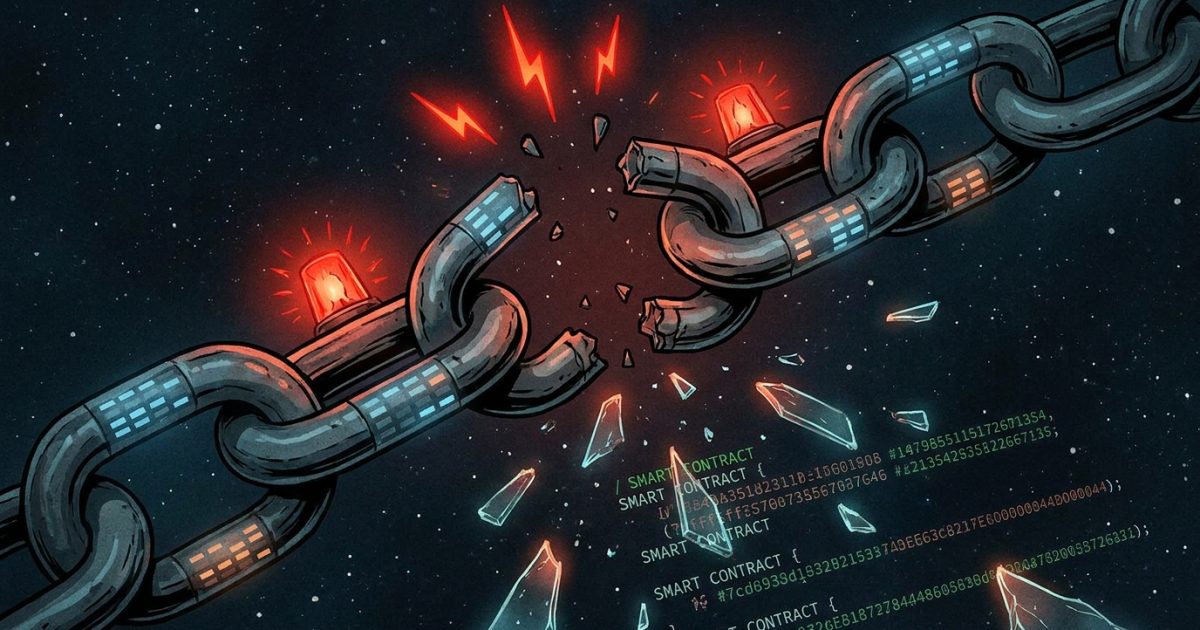

ZetaChain shut down all cross-chain transactions on its mainnet Monday after attackers exploited the network’s GatewayEVM smart contract, draining roughly $300,000 from internal team wallets.
The Layer 1 interoperability network said it detected the breach quickly and closed the attack vector before losses could escalate. User funds weren’t affected, according to the team. But nine hours after the initial response, ZetaChain’s status page still showed cross-chain transactions as halted – a full operational freeze on a network whose entire purpose is moving assets between blockchains.
What Happened
The GatewayEVM contract serves as ZetaChain’s single entry point between applications on its network and external EVM-compatible chains like Ethereum, Polygon, and BNB Chain. An attacker found a way to exploit this contract and siphon funds from ZetaChain’s own operational wallets.
Blockchain security firm Blockaid flagged the incident and warned users to revoke any approvals they had granted to the GatewayEVM contract address. ZetaChain confirmed the warning and said a detailed post-mortem would follow once the investigation wraps up.
The $300,000 loss is small compared to other bridge exploits this year, but the operational shutdown tells a bigger story. When a network built around interoperability has to freeze its core function, the damage goes beyond the dollar amount.
April’s Brutal Exploit Tally
This isn’t an isolated event. According to data compiled by DeFiLlama and multiple security firms, more than $606 million has been stolen from DeFi protocols in just the first 18 days of April 2026. That makes this month the worst for crypto hacks since the Bybit breach in February 2025.
The largest chunk traces back to the KelpDAO exploit that created a cascade across Aave, triggering a $10 billion liquidity run and forcing a multi-hundred-million-dollar rescue operation. That breach has since pulled in industry heavyweights – Aave, DeFi United, and dozens of allied protocols pooling resources to restore the lending platform’s health.
ZetaChain’s exploit adds another line to an increasingly grim ledger.
The Bridge Problem That Won’t Go Away
Cross-chain bridges remain the softest target in DeFi. The Ronin hack ($624 million, 2022), the Wormhole exploit ($326 million, 2022), and the Nomad drain ($190 million, 2022) all hit bridge infrastructure. Four years later, the pattern hasn’t changed – only the names rotate.
ZetaChain positions itself as a “universal blockchain” designed to solve the interoperability problem more securely than traditional bridges. Its architecture differs from wrapped-asset bridges because it uses a native omni-chain approach. But the GatewayEVM contract still sits at the boundary between networks, and boundaries are where attackers look first.
The network launched its mainnet in early 2024 and has been building out integrations across Bitcoin, Ethereum, and several other chains since then.
ZETA Price Reaction
ZETA dropped 5.3% in the 24 hours following the exploit announcement, trading near $0.05. Technical indicators show a neutral RSI at 51.41, with the token sitting below its 20-day exponential moving average of $0.0536. Support levels sit at $0.0528 and $0.0453, while resistance clusters around $0.058 and $0.062.
The modest price reaction suggests the market views this as contained – for now. If the post-mortem reveals deeper architectural issues or the mainnet stays paused for days, that calculus could shift.
What ZetaChain Users Should Do
Anyone who interacted with the GatewayEVM contract should revoke approvals immediately. Tools like Revoke.cash and Etherscan’s token approval checker can handle this. ZetaChain hasn’t specified a timeline for restoring cross-chain functionality.
The team said it will publish a full autopsy report once the investigation concludes. Until then, cross-chain transfers on ZetaChain remain frozen.
FAQ
Were user funds affected in the ZetaChain exploit?
ZetaChain says no. The team claims only internal operational wallets were drained. Independent verification hasn’t yet confirmed this.
How long will ZetaChain cross-chain transactions stay paused?
No timeline has been given. The status page still showed transactions halted nine hours after the breach was detected.
Should I revoke my ZetaChain approvals?
Yes. If you granted any approvals to the GatewayEVM contract, revoke them through Revoke.cash or your wallet’s built-in approval manager until the post-mortem is published.