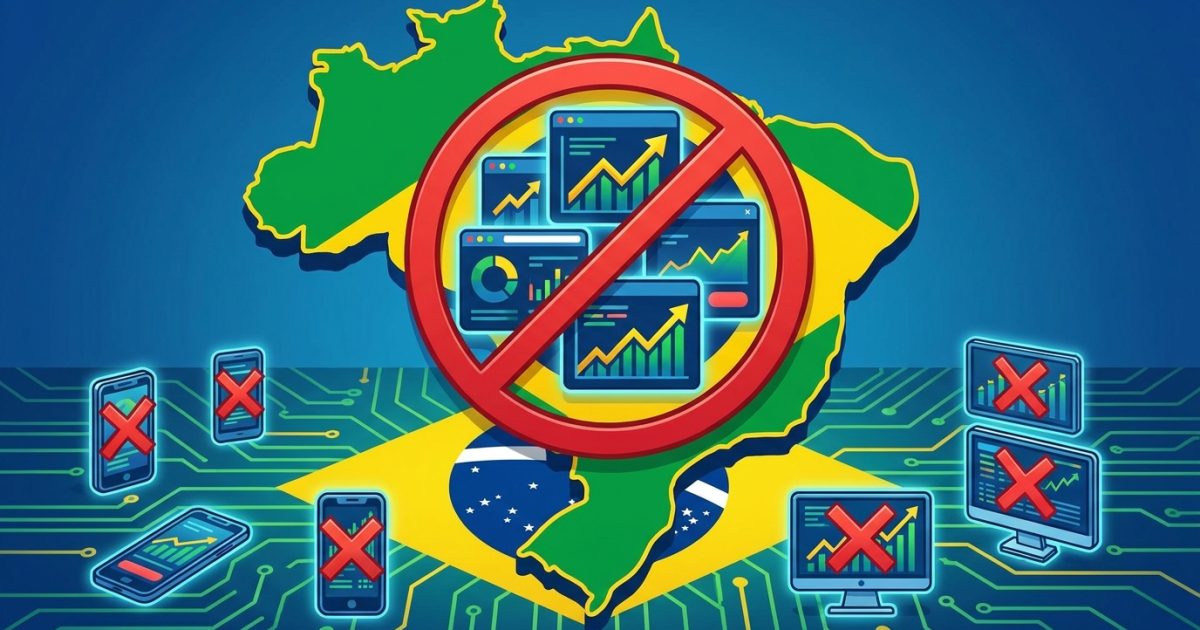

Brazil’s government moved quickly on Thursday to shut the door on crypto-native prediction markets, blocking access to Polymarket, Kalshi, and at least 26 other platforms in one of the broadest regulatory actions against the sector this year.
The ban, announced by Finance Minister Dario Durigan and executed through the Brazilian Central Bank, targets platforms that the government says fail to meet regulatory requirements for derivatives trading and pose unacceptable risks to investor protection and market integrity.
What Brazil Actually Did
The Finance Ministry issued a directive citing federal gambling laws and existing securities regulations. Internet service providers in Brazil have been instructed to block access to the named platforms.
Approximately 28 platforms are covered by the ban. Polymarket and Kalshi – the two largest prediction market operators globally – are the most prominent names on the list. Both platforms allow users to bet on the outcomes of real-world events ranging from elections and policy decisions to sports results and economic indicators.
Brazil’s Central Bank stated that prediction markets operating within the country must comply with derivatives trading requirements, which none of the blocked platforms had sought or obtained.
The sweep appears to be the most aggressive single-country action against prediction markets since the sector exploded in popularity during the 2024 U.S. presidential election cycle. Polymarket processed more than $3 billion in trading volume during that race alone and has continued growing.
Why It Matters for Crypto
Prediction markets are one of the fastest-growing sectors at the intersection of crypto and traditional finance. Polymarket runs on the Polygon blockchain and settles trades using USDC stablecoins. Kalshi, while not blockchain-based, operates under a CFTC-regulated system in the United States and has fought its own legal battles to offer event contracts.
Brazil is Latin America’s largest economy and one of the world’s most active crypto markets. The country ranks among the top 10 globally for cryptocurrency adoption, according to Chainalysis, and has more than 20 million crypto users.
The ban sets a precedent that other nations may follow. While the United States has gradually expanded the legality of prediction markets – Kalshi won a federal court ruling last year permitting election contracts – Brazil’s move suggests developing economies may take the opposite approach.
Gambling Addiction and Investor Protection Cited
Finance Minister Durigan framed the decision partly as a public health measure, citing rising concerns about gambling addiction among younger Brazilians. The country has seen a proliferation of online betting apps, and legislators have pushed for tighter controls across the broader gambling sector.
The government’s position treats prediction markets as a subset of gambling rather than as a distinct financial instrument or information market. That classification is significant. If other regulators adopt the same framing, it could undermine the industry argument that prediction markets serve a unique role in aggregating public information and forecasting real-world events.
Polymarket hasn’t issued a public statement on the Brazilian ban. Kalshi declined to comment.
How Enforcement Will Work
ISP-level blocking is the primary mechanism. Brazil has used this approach before against unlicensed gambling operators and certain social media platforms. The technique prevents most casual users from accessing blocked sites, though VPN usage can circumvent the restrictions.
For crypto-native platforms like Polymarket, the enforcement challenge is inherent. Users with existing wallets and positions can still interact with the smart contracts directly – the block targets the web interface, not the underlying blockchain infrastructure.
That said, the practical impact is substantial. The vast majority of prediction market users access platforms through web browsers, and ISP blocking reduces mainstream adoption even if it doesn’t eliminate access entirely.
Global Regulatory Patchwork
The Brazilian ban highlights the increasingly fragmented global approach to prediction markets:
- United States: Kalshi operates under CFTC oversight. Polymarket settled with the CFTC in 2022 and currently restricts U.S. users from its main platform.
- European Union: MiCA regulations don’t specifically address prediction markets, leaving enforcement to individual member states.
- India: Prediction markets operate in a legal gray area, with some states classifying them as games of skill rather than gambling.
- Singapore: The Monetary Authority of Singapore has flagged prediction markets as potentially requiring securities licensing.
Brazil’s outright block stands at the restrictive end of this spectrum and could embolden other Latin American regulators considering similar steps.
What Happens Next
The immediate effect is reduced access for Brazilian users, who represent a meaningful share of both platforms’ user bases. Longer-term, the ban could force prediction market operators to decide whether to pursue regulatory engagement in Brazil or simply write off the market.
For Polymarket, the decision also carries a broader strategic implication. The platform has been exploring compliance frameworks in multiple jurisdictions and recently hired a head of regulatory affairs. A ban in one of the world’s largest crypto markets complicates that approach.
FAQ
Can Brazilian users still access Polymarket through VPNs?
Technically, yes. ISP-level blocking targets the website area but doesn’t prevent VPN users from bypassing restrictions. But, using a VPN to access banned financial services may carry legal risk under Brazilian law.
Are other countries likely to follow Brazil’s approach?
It’s possible. Several countries in Latin America, Southeast Asia, and Africa are monitoring prediction market growth. Brazil’s ban could serve as a regulatory template, particularly for nations that classify prediction markets as gambling rather than financial instruments.
Does this affect Polymarket’s blockchain contracts?
No. The underlying smart contracts on Polygon remain accessible to anyone with a crypto wallet. The block targets the web interface, not the on-chain infrastructure. But, most retail users rely on the web interface for trading.
Sources: Bloomberg, The Block, Yahoo Finance, Phemex