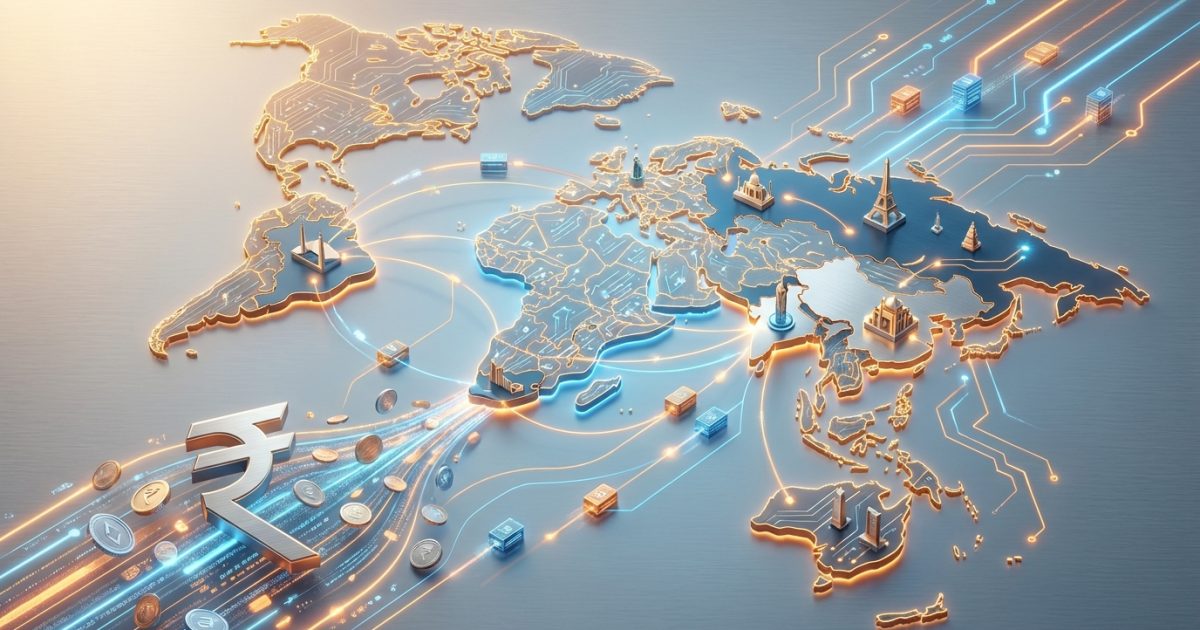

India is betting that the fastest path to mass central bank digital currency adoption runs through welfare payments – and it’s staking a geopolitical play on the result.
The Reserve Bank of India is running about 10 pilot programs that route portions of the country’s roughly $80 billion welfare system through the e-rupee, according to a Reuters report published Thursday. Separately, India is pushing a proposal to link CBDCs across all BRICS member states ahead of the bloc’s 2026 summit, an effort that would connect the digital currencies of Brazil, Russia, India, China, and South Africa into a cross-border payment network.
Together, these moves represent the most ambitious CBDC deployment strategy from any major economy this year.
How the Welfare Pilots Work
In Maharashtra’s Phulenagar village, farmers receive programmable subsidies that cover up to 80 percent of drip irrigation costs. The catch: the funds can only be spent at approved vendors. This programmability – built directly into the digital currency – eliminates the middlemen and leakage that have plagued India’s subsidy programs for decades.
A separate pilot in Gujarat aims to onboard all 7.5 million households eligible for subsidized food by June. The target is aggressive. If Gujarat hits that number, it would represent the single largest CBDC user deployment in any country to date.
Other pilots cover fertilizer subsidies, rural employment guarantees, and education stipends. Each uses the same core mechanism: programmable money that can only be spent for its stated purpose, with every transaction recorded on a ledger controlled by the Reserve Bank.
The Scale Problem India Hasn’t Yet Solved
Despite the ambition, India’s CBDC numbers remain modest. The e-rupee has grown to roughly 10 million users from about 7 million earlier in 2026. Cumulative transactions since the currency’s December 2022 launch total just $3.6 billion.
That’s a rounding error compared with India’s Unified Payments Interface (UPI), which processes approximately $300 billion in transactions every month. UPI already works on smartphones and feature phones, accepts payments at street vendors, and requires no understanding of digital currency mechanics.
For the e-rupee to justify its existence alongside UPI, it needs to offer something UPI can’t: programmability, direct government control over subsidy flows, and cross-border interoperability.
The first two are what the welfare pilots aim to prove. The third is the BRICS angle.
The BRICS CBDC Linkage Proposal
The Reserve Bank of India has urged the Indian government to advance a proposal at the 2026 BRICS summit that would connect member nations’ CBDCs into an interoperable network. Rather than creating a single shared currency – an idea that carries massive sovereignty concerns – the plan would let existing national digital currencies like India’s e-rupee and Brazil’s Drex settle cross-border transactions directly.
The objective is faster and cheaper international payments for trade, tourism, and financial flows, while reducing dependency on the U.S. dollar as a settlement currency.
Modern Diplomacy reported that the RBI’s proposal gives particular attention to technical interoperability standards, aiming to create a system that additional countries could eventually join.
The expanded BRICS membership – which now includes major energy producers Saudi Arabia, UAE, Iran, Egypt, and Ethiopia – makes the bloc a meaningful force in global trade. A functioning CBDC payment rail connecting these economies could handle a significant share of cross-border transactions that currently route through dollar-denominated correspondent banking.
The Geopolitical Risk
This is where it gets complicated. President Donald Trump has specifically threatened tariffs on BRICS nations that pursue alternatives to the dollar. The United States has already imposed duties on Indian imports, tied partly to India’s purchases of Russian crude oil.
Pushing a CBDC network designed to reduce dollar dependency while sitting under U.S. trade pressure is a calculated risk. India appears to be managing it by framing the CBDC linkage as a payments efficiency measure rather than a dollar replacement – a distinction that may or may not satisfy Washington.
What Other Countries Are Watching
India’s welfare pilot approach could become a template. The fundamental insight is straightforward: instead of asking citizens to voluntarily adopt a new form of money, route benefits they already depend on through the new system. Adoption becomes a side effect of collecting your subsidy check.
China’s digital yuan has used a similar playbook with lottery-style airdrops and merchant subsidies, but China hasn’t attempted to funnel its welfare system through the e-CNY at the scale India is now targeting.
Nigeria’s eNaira and the Bahamas’ Sand Dollar both launched with consumer-facing approaches and struggled with adoption. India’s gamble is that welfare routing solves the demand problem that has plagued every CBDC launch to date.
FAQ
What is the e-rupee?
The e-rupee is India’s central bank digital currency, issued and controlled by the Reserve Bank of India. It functions as a digital form of the Indian rupee and is designed for both retail and wholesale transactions. Programmability allows the RBI to restrict how certain funds can be spent.
How would a BRICS CBDC network affect the U.S. dollar?
If successfully set up, a BRICS CBDC network could reduce demand for dollar-denominated correspondent banking in cross-border trade among member nations. The practical impact would depend on adoption levels and whether the network achieves meaningful transaction volume. Some analysts view it as a long-term challenge to dollar dominance; others see it as a niche payment rail.
Can India’s approach be replicated by other countries?
In principle, yes. Any country with a large welfare system and a CBDC could route subsidies through digital currency wallets. The key requirements are digital identity infrastructure, mobile phone penetration, and a merchant acceptance network – all of which India has built through its Aadhaar and UPI systems.
Sources: CoinDesk, Reuters, Modern Diplomacy