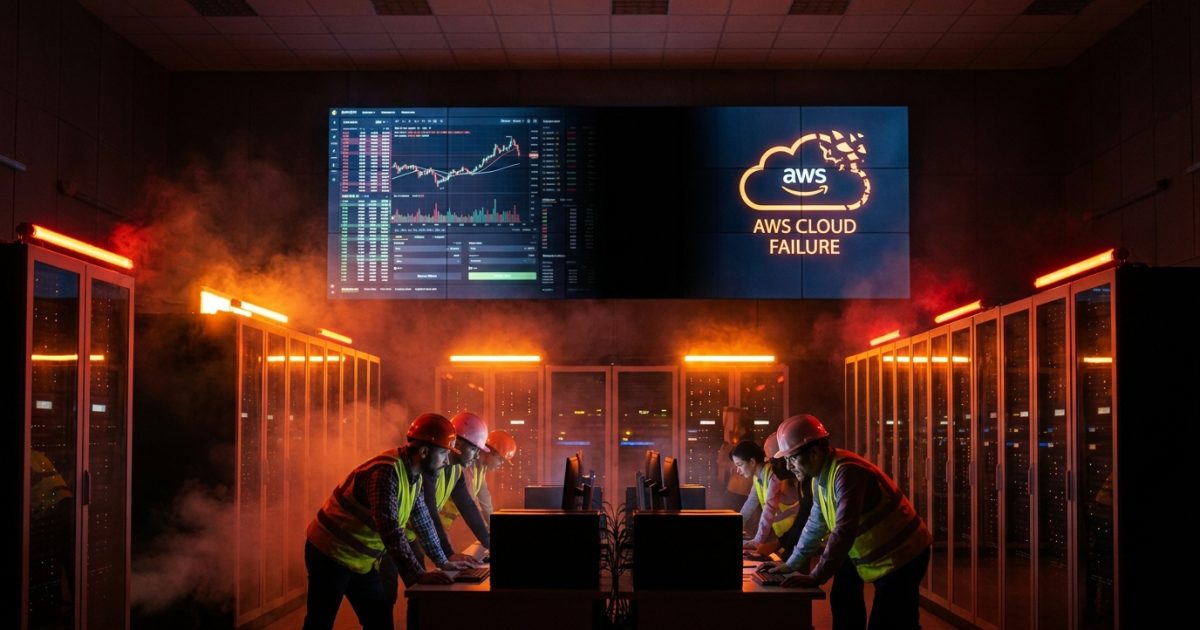

Coinbase CEO Says AWS Outage Is ‘Never Acceptable’ After Five-Hour Exchange Downtime
Coinbase traders were left staring at error screens for roughly five hours last week after an AWS data center overheated in northern Virginia, knocking out trading functionality for one of the world’s largest crypto exchanges at a particularly sensitive time.
The outage hit on May 8, when a cooling failure at Amazon Web Services’ primary US-East-1 region caused an availability zone to go offline. The ripple effects touched a range of AWS-dependent services, including FanDuel, but the crypto community focused heavily on Coinbase — the most high-profile name among affected platforms.
“Full recovery is still expected,” AWS said in a status update during the incident, and service was eventually restored. But for traders who missed moves during a period of active crypto market action, “eventually” wasn’t reassuring.
What Actually Happened
According to AWS, the incident was caused by overheating at a data center facility in the company’s main US-East-1 region hosted in northern Virginia. The failure triggered an availability zone outage — one of the more severe categories of AWS incident, where entire clusters of servers become unreachable rather than just individual services degrading.
Coinbase confirmed the disruption publicly. The exchange’s status page showed impacted services, though the company was careful to note that customer funds were not at risk. The disruption affected trading functionality — the ability to buy and sell — rather than the custody infrastructure where assets are held.
CNBC reported that the outage affected trading on both FanDuel and Coinbase, with “recovery expected to take hours” — a timeline that ultimately proved accurate.
Armstrong’s Response
Coinbase CEO Brian Armstrong took an unusually direct tone in addressing the incident publicly. He called the five-hour outage “never acceptable,” framing it not as an inevitable result of third-party infrastructure failure but as something his company must solve.
Armstrong acknowledged that the AWS failure did not affect most of Coinbase’s core design systems, which remained operational during the outage. The trading downtime was concentrated in specific services dependent on the affected AWS availability zone.
The CEO’s comments reflect pressure on Coinbase from multiple directions. The company reported a Q1 2026 loss, and the outage timing drew criticism from traders and commentators who pointed to staff layoffs earlier in the year as a possible factor in infrastructure resilience decisions.
“Coinbase disruption tied to AWS outage draws criticism amid staff layoffs and Q1 losses,” CoinDesk reported in covering the incident and its fallout.
Why This Is a Bigger Issue Than One Outage
The incident reignites a debate that the crypto industry has avoided addressing directly: major crypto exchanges are fundamentally centralized infrastructure businesses, and they run on the same cloud providers as any other web company.
That centralization creates shared single points of failure. When AWS’s Virginia region has a bad day, it doesn’t just affect a startup — it affects the trading liquidity of assets held by millions of users worldwide. For an industry that bills itself as an alternative to traditional centralized finance, that’s an uncomfortable irony.
Decentralization advocates have long argued that on-chain, non-custodial trading venues — DEXs — provide a structural advantage over centralized exchanges precisely because they don’t depend on any single data center or cloud provider. Monday’s Arbitrum DAO governance activity on the Kelp exploit recovery continued without interruption during the same period Coinbase was down.
That said, the majority of crypto volume still routes through centralized exchanges, and most users prefer the user experience, liquidity, and regulatory comfort of a platform like Coinbase over the complexity of managing self-custody and interacting with DEXs.
Infrastructure Resilience in Focus
The outage adds pressure on Coinbase to accelerate its multi-region, multi-cloud redundancy buildout — or at minimum, to be more transparent about the architectural decisions behind why a single AWS availability zone could take down core trading functions.
For context, traditional stock exchanges operate under explicit regulatory requirements for business continuity and disaster recovery. NYSE, NASDAQ, and CME Group are required to demonstrate that they can recover from severe infrastructure failures within defined time windows. Crypto exchanges, operating under lighter regulatory touch, have had more latitude — but that latitude is narrowing as the industry grows and regulators pay closer attention.
The SEC, CFTC, and the incoming digital asset regulatory framework contemplated by the Clarity Act could eventually extend infrastructure resilience requirements to crypto trading venues. The Coinbase outage is exactly the kind of event that regulators point to when making that argument.
FAQ
Q: Were Coinbase customer funds at risk during the AWS outage?
A: No. Coinbase confirmed that customer funds were not affected. The outage impacted trading functionality — the ability to place and execute trades — while custody infrastructure remained operational.
Q: How long was Coinbase down during the AWS outage?
A: Trading was disrupted for approximately five hours on May 8, 2026, tied to an AWS US-East-1 availability zone failure caused by overheating at a Virginia data center.
Q: Is Coinbase taking steps to prevent future outages?
A: CEO Brian Armstrong described the outage as “never acceptable,” but specific infrastructure changes haven’t been publicly announced. Analysts expect pressure to increase for multi-region cloud redundancy or hybrid-cloud architectures following the incident.
Sources: CNBC, CoinDesk, Stocktwits, Coinbase Status Page, CCN. This article is for informational purposes only.



The Smartest Way to Buy Steam Games Using Bitcoin in 2026 https://steamgame.pages.dev