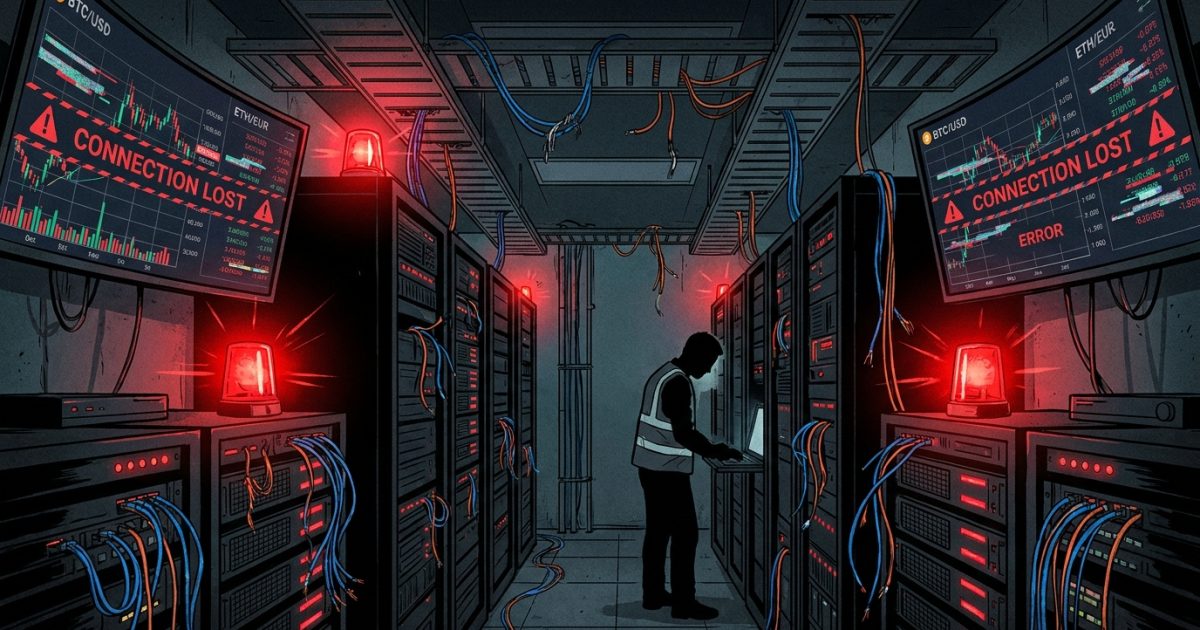
Coinbase, one of the world’s largest cryptocurrency exchanges, suffered a prolonged trading outage on Friday after an Amazon Web Services infrastructure failure in the United States knocked out platform access for thousands of users — arriving at the worst possible moment, hours after the exchange posted strong first-quarter 2026 earnings.
The disruption, which lasted between two and five hours depending on which services users attempted to access, was traced to a thermal event at AWS’s US-EAST-1 data centre in Northern Virginia, a cloud region that underpins a substantial portion of Coinbase’s backend trading infrastructure.
What Happened and When
Coinbase’s official status page first flagged “degraded performance” in the early hours of Friday morning, noting that some users were unable to place trades or access account functions. The company’s engineering team confirmed it was investigating and attributed the root cause to the AWS outage affecting multiple services.
AWS, a subsidiary of Amazon and one of the dominant providers of cloud infrastructure for financial services firms worldwide, confirmed a thermal incident at its us-east-1 region. Thermal events — typically caused by cooling system failures or server overheating — can cascade quickly across interconnected services, particularly in high-traffic environments like crypto exchanges where milliseconds matter.
For retail traders watching bitcoin briefly breach $80,000 during the same window, the inability to execute trades carried real financial consequences. Several users reported on social media that their stop-loss orders were not triggered, buy orders were rejected, and account balances failed to update in real time.
Ironic Timing: Earnings Day Disruption
The outage hit on the same day Coinbase released its Q1 2026 earnings — results that analysts described as broadly positive. Chief Financial Officer Alesia Haas revealed during the earnings call that the exchange purchased $88 million worth of bitcoin during the quarter, adding to its growing corporate treasury.
Haas also confirmed that Coinbase’s USDC revenue-sharing contract with stablecoin issuer Circle auto-renews every three years in perpetuity and cannot be terminated unilaterally — a detail that underscored how structurally embedded stablecoin income has become within the exchange’s revenue model.
The earnings call painted a picture of a resilient, growing business. The outage that followed within hours provided an uncomfortable reminder of the infrastructure dependencies that underlie even the largest crypto platforms.
Cloud Dependency: A Structural Risk for Crypto
The incident has renewed debate about the degree to which crypto exchanges — platforms built on the narrative of decentralisation — depend on centralised cloud providers. AWS, Microsoft Azure, and Google Cloud collectively power the majority of the world’s largest cryptocurrency exchanges, custodians, and data providers.
When AWS experiences a regional failure, the effects rarely stay contained. Multiple crypto platforms reported service disruptions on Friday coinciding with the Northern Virginia outage, suggesting the issue extended beyond Coinbase alone.
Critics have long argued that this dependency creates a systemic point of failure for an industry that markets itself as resilient to single points of control. Supporters counter that cloud infrastructure is the most reliable and cost-efficient option available, and that multi-region redundancy strategies can mitigate most risks.
“The question isn’t whether to use cloud infrastructure — it’s how many redundant regions you have and how fast your failover kicks in,” said one infrastructure engineer who tracks exchange uptime. “Five hours is a long time for an exchange of Coinbase’s scale.”
Not the First Time
This is not the first time Coinbase has faced extended downtime during significant market events. The exchange has experienced notable outages during previous periods of high volatility, drawing regulatory scrutiny and user criticism. The pattern has prompted calls from some consumer advocates for crypto exchanges to be held to uptime standards similar to those applied to traditional brokerage platforms.
Coinbase has not publicly disclosed compensation plans for users who missed trades during the outage window.
Coinbase’s Response
As of Friday afternoon, Coinbase had restored full service and posted an incident report noting that the AWS thermal event triggered a cascading failure across dependent microservices. The company said it is reviewing its multi-region failover architecture in response to the incident.
No user funds were lost or compromised during the outage. Coinbase confirmed that custodial assets remained secured throughout the disruption.
Market Context
The outage coincided with bitcoin testing and then retreating from the $80,000 level, a psychologically significant price point that attracted heavy media coverage. Some traders speculated that the inability to buy during the early-morning spike may have contributed to thinner liquidity and amplified volatility.
Coinbase’s stock (COIN) was trading down approximately 2% in pre-market activity as the outage news spread, though analysts attributed most of that move to broader risk-off sentiment rather than the outage itself.
FAQ
Was Coinbase hacked during the May 8 outage?
No. Coinbase confirmed the disruption was caused by an Amazon Web Services infrastructure failure — specifically a thermal event at the us-east-1 data centre in Northern Virginia. No user funds were compromised, and there is no evidence of any security breach.
How long was Coinbase down on May 8, 2026?
Depending on which services users were trying to access, the outage lasted between two and five hours. Trading was the most severely affected function, with some users also reporting inability to access account balances and view real-time price data.
Does the Coinbase outage expose a bigger problem for crypto exchanges?
The incident highlights the reliance of centralised crypto exchanges on traditional cloud providers like AWS. Critics argue this creates systemic risk for platforms that market themselves as resilient alternatives to legacy finance. Multi-region redundancy is the standard mitigation strategy, but Friday’s event showed it is not always sufficient to prevent extended outages.
Sources: news.bitcoin.com, CoinCentral, CryptoTimes, Yahoo Finance, CoinFomania, Coinbase status page