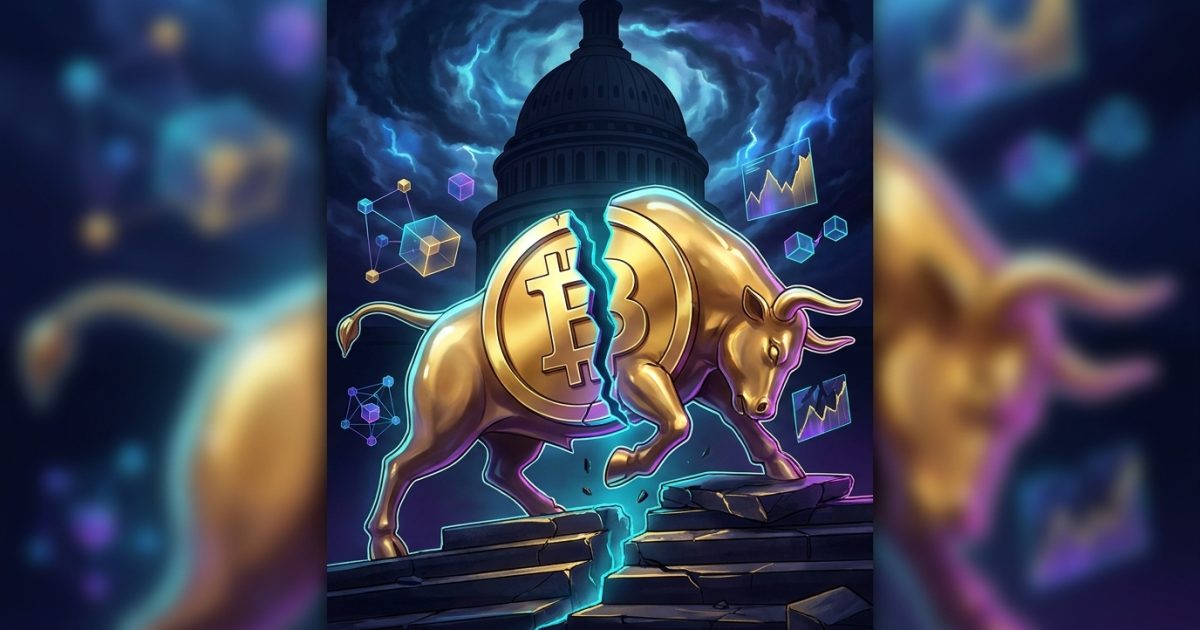
Democrats Sweep Midterms, Ending Crypto’s Two-Year Political Run in Washington
The cryptocurrency industry’s extraordinary run of political good fortune in Washington has come to an abrupt halt. Democrats are set to control both chambers of Congress following their midterm sweep, a result that hands the digital asset sector the prospect of tougher rules and far closer scrutiny of its ties to President Donald Trump.
The shift marks a dramatic reversal for an industry that, for two years, enjoyed something few businesses ever obtain in the nation’s capital: a president who made digital assets a national priority while amassing his own crypto fortune, regulators clearing a path for wider adoption, and a Republican Congress broadly sympathetic to its agenda.
The report, published on 7 November 2026 by Teresa Xie and Scott Patterson, captures the moment the industry’s political momentum stalls. A widely circulated image from the period shows a cutout of President Trump holding a Bitcoin token during the Bitcoin 2025 conference in Las Vegas, a visual shorthand for how tightly the industry’s fortunes had become bound to one political figure and one party.
How the Boom Years Unfolded
To understand the severity of the reversal, it is worth recalling just how favourable the preceding period had been. Under President Trump, digital assets were elevated from a regulatory afterthought to a stated national priority. That stance filtered through the administrative state. Regulators cleared a path for wider adoption of crypto products, a departure from the enforcement-heavy posture that had previously defined federal policy towards the sector.
Congress, controlled by Republicans for the first two years of the Trump presidency’s current term, proved sympathetic to the industry’s legislative agenda. For an industry that had spent the better part of a decade fighting defensive battles in Washington, the arrangement was close to ideal: a friendly executive, accommodating regulators and a compliant legislature.
There was, however, an unusual complication at the centre of it all. The president himself amassed a personal crypto fortune while simultaneously setting national policy for the sector. That entanglement, largely tolerated while Republicans held power, now becomes the industry’s most exposed flank. With Democrats preparing to take control of Congress, the ties between the industry and the Trump family’s own digital asset interests are likely to attract the kind of congressional attention that a friendly majority would never have countenanced.
What Democratic Control Means for the Sector
The immediate consequence of the midterm result is legislative. A Democratic Congress is positioned to shape the rules governing digital assets, and the industry faces the prospect of tougher oversight than anything it confronted during the boom years. Committee chairs in both the House and Senate gain subpoena power, control of hearing agendas and the ability to drive investigations. For an industry whose Washington strategy was built on access to a sympathetic Republican majority, the machinery of oversight is about to be pointed in the opposite direction.
Three areas of exposure stand out.
First, the scrutiny of ties to President Trump. The president’s personal crypto fortune, accumulated while in office and while setting policy for the sector, is the most conspicuous target. Democratic lawmakers have every incentive to examine whether policy decisions that benefited the industry also benefited the president’s own holdings. Any such inquiry would inevitably pull in the exchanges, issuers and project operators that engaged with the Trump family’s ventures.
Second, the regulatory thaw itself. Rules and guidance that cleared the path for wider adoption were products of an administration that treated crypto as a priority. A Democratic Congress can legislate to constrain that framework, impose stricter disclosure and consumer protection requirements, or mandate studies and audits that slow the pace of institutional adoption. Even where legislation stalls, the threat of it changes behaviour. Firms that expanded aggressively on the assumption of continued political favour now face a colder compliance calculus.
Third, the broader question of whether the industry’s political strategy was sound at all. Crypto effectively bet its Washington future on one party and one president. That bet paid off handsomely for two years. The midterm result shows the other side of concentrated political risk: when the favoured party loses, the industry loses with it, and it has comparatively few friends on the incoming side to soften the blow.
For ongoing reporting on the political and regulatory dimension of digital assets, readers can follow our regulation coverage, where we track congressional action and its market consequences.
Market Implications: Pricing Political Risk Back In
The market dimension of this shift deserves particular attention. Political fortune has been a genuine driver of crypto valuations during the boom period. A president who championed digital assets, regulators who permitted wider adoption and a friendly Congress collectively reduced the policy risk premium embedded in token prices. Institutional flows that might previously have stayed away from a legally uncertain asset class found the environment welcoming.
Democratic control of Congress reverses that logic. The policy risk premium that had been compressed over two years now widens again. Traders and allocators will need to price in the possibility of hostile hearings, restrictive legislation and renewed regulatory friction. Assets and firms most closely associated with the Trump orbit are the most directly exposed, since scrutiny of the president’s crypto ties will inevitably extend to his partners and counterparties.
There is also a reputational dimension. The industry’s identification with a single political figure, symbolised by that Las Vegas cutout of Trump holding a Bitcoin token, now functions as a liability. Digital assets had spent years arguing they were a neutral, global technology. Two years of partisan alignment undermined that claim, and the midterm result forces the sector to rebuild credibility with the half of the American political system it did not court.
The industry’s lobbying apparatus, which grew substantially during the boom, will not disappear. But its effectiveness depends on having doors open on both sides of the aisle, and those doors are now markedly less open on the Democratic side. Expect the sector’s Washington presence to pivot quickly towards damage limitation: emphasising consumer protection commitments, distancing itself from the most politically fraught ventures and searching for Democratic lawmakers willing to engage.
Whether that pivot succeeds is an open question. Congressional Democrats arrive with momentum from a midterm sweep and a ready-made narrative about an industry that prospered under uniquely favourable and arguably improper conditions. The burden of proof has shifted. For two years, crypto asked Washington for permission and largely received it. Now it must prepare to justify itself.
Analysis: The Cost of a One-Party Bet
The endgame of crypto’s Washington boom carries a lesson that extends beyond digital assets. The industry received something rare in American politics: simultaneous favour from the executive, the legislature and the regulators. Rather than hedging, it leaned in, tying its public identity to a president who was simultaneously its most powerful patron and, through his own crypto fortune, one of its most prominent participants.
That concentration of political risk was manageable while the coalition held. The midterm sweep broke it. The industry now faces tougher rules, closer scrutiny of its Trump ties, and the loss of the legislative tailwind that defined its best years in Washington.
The most consequential question is not whether regulation tightens. It almost certainly will. The question is whether the sector can decouple its long-term value proposition from partisan fortune before the next political cycle. Bitcoin was conceived, after all, as a system that needed no one’s permission. The past two years in Washington tested that premise and found the industry eagerly seeking permission anyway. The bill for that dependence has now arrived, and it will be paid in oversight, in hearings and in a regulatory climate far less forgiving than the one crypto leaves behind.
For continued coverage of how these developments affect the largest digital asset, see our Bitcoin coverage.