Meta description: MENA Blockchain Week 2026 wrapped in Dubai with 5,000 attendees and a clear message: the Middle East is positioning itself as the world’s leading crypto-friendly jurisdiction.
Focus keyword: MENA Blockchain Week Dubai 2026
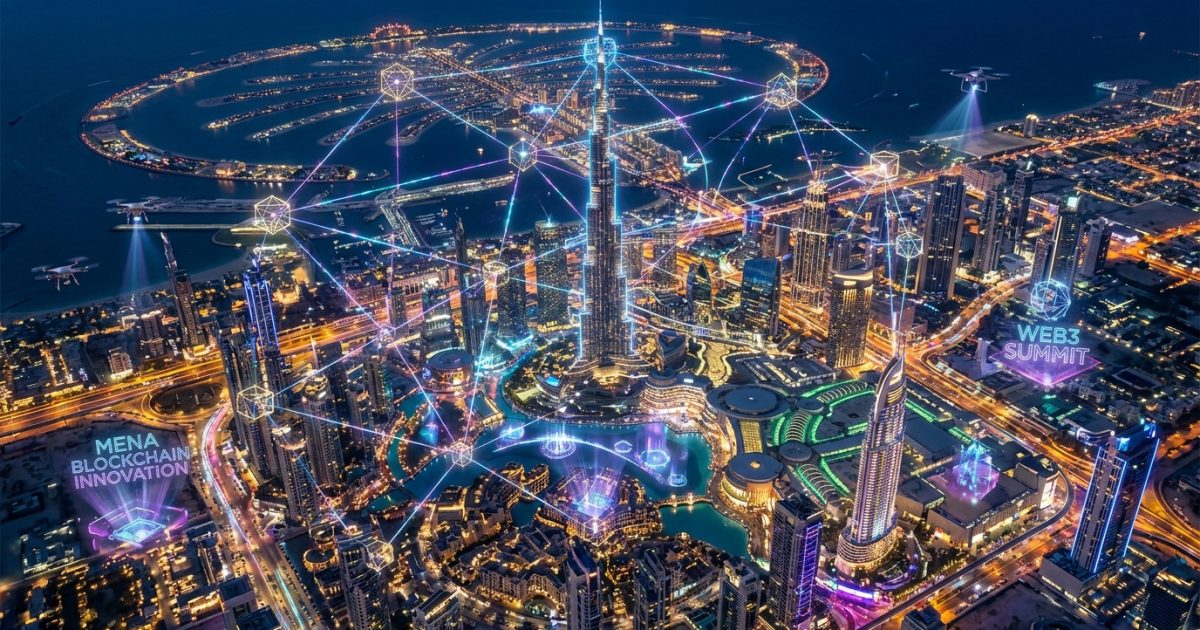
MENA Blockchain Week wrapped up in Dubai on 24 May 2026 after seven days of panels, announcements, side events, and networking that drew roughly 5,000 attendees to venues spread across the city. The event, billed as the region’s first decentralised, city-wide blockchain initiative, was structured deliberately to mirror Dubai’s broader approach to Web3: spread out, commercially focused, and designed to create deals rather than just conversations.
The closing message from organisers and speakers alike was unambiguous. The Middle East has picked a side in the global competition to host the next decade of digital asset infrastructure — and that side is open for business.
Format and Scale
MENA Blockchain Week (MENABCW) ran from 18 to 24 May 2026, using Dubai’s existing event infrastructure rather than a single convention centre. The main hub was Dubai Founders HQ at 25hours Hotel One Central, but dozens of side events were held across venues in Downtown Dubai, Dubai Marina, and DIFC.
The “city as venue” model was conscious. Organisers described it as reflecting the way serious blockchain business actually happens — across meeting rooms, hotel lobbies, and dinners rather than keynote stages. Critics of large single-venue crypto conferences have long argued that the real value comes from side events and informal meetings, and MENABCW’s format was built around that observation.
The 5,000 attendee figure covers official pass holders. The total footprint of affiliated side events likely brought the full participant count considerably higher.
Key Themes and Announcements
Several themes dominated the week’s programming and deal announcements.
Real-world asset tokenisation. Multiple regional sovereign wealth fund representatives and private equity firms discussed active exploration of RWA tokenisation frameworks. Dubai’s existing digital asset regulatory infrastructure — administered through the Virtual Assets Regulatory Authority (VARA) — was repeatedly cited as a key enabler. The global tokenised treasury market crossed $15 billion earlier in 2026, led by BlackRock and JPMorgan, and Gulf-based institutions were described at MENABCW as eager to participate at scale.
Institutional custody. Several global custodians with Middle East presences announced expanded digital asset custody services targeting MENA institutional clients. The interest was driven partly by sovereign wealth fund mandates that have begun including crypto exposure requirements.
Cross-border payments. The week included a dedicated track on stablecoin infrastructure for cross-border remittances — a particularly relevant topic in the UAE, which is home to one of the world’s largest expatriate populations. Multiple stablecoin issuers announced partnerships with UAE-based payment providers.
AI and blockchain integration. The intersection of artificial intelligence and on-chain infrastructure drew significant attention, with several startups demoing AI-driven DeFi risk management tools and on-chain AI agent frameworks.
Dubai’s Regulatory Positioning
Much of the week’s subtext was about regulation — specifically, Dubai’s ability to offer what the United States, European Union, and United Kingdom have so far struggled to provide: a clear, operational licensing framework that allows crypto businesses to operate with legal certainty.
VARA, established in 2022, has issued licences to dozens of crypto exchanges and service providers and is increasingly seen as a model for how mature jurisdictions can regulate digital assets without driving them offshore. Several executives at MENABCW contrasted VARA’s approach favourably with the ongoing legislative uncertainty in the US — even as the CLARITY Act moves through the Senate.
“We don’t wait for a court case to tell us what we can do,” one licensed exchange CEO said during a panel on regulatory arbitrage. “We have a framework. We have a regulator we can sit across the table from. That is worth more than any tax incentive.”
The Competition Picture
Dubai is not the only city competing for crypto’s institutional business. Singapore, Hong Kong, and Switzerland have all made significant moves to attract digital asset firms in 2026. But MENABCW attendees largely characterised the competitive dynamic as less zero-sum than it appeared two years ago.
The market has grown large enough that multiple jurisdictions can host thriving crypto ecosystems simultaneously. What matters now, several executives argued, is which jurisdiction moves fastest and most clearly on institutional-grade custody, tokenisation, and payments infrastructure — areas where Dubai’s combination of VARA regulation, no capital gains tax, and world-class logistics infrastructure gives it a structural advantage.
What Comes Next
MENABCW organisers have not yet announced dates for a 2027 edition, but the format is expected to be repeated. Several of the larger side event organisers have already committed to returning.
More immediately, the conversations that began at MENABCW are expected to produce a series of formal partnership and investment announcements over the following weeks. In previous years, Dubai crypto weeks have been reliable leading indicators of capital flows into the region’s digital asset ecosystem.
For an industry that has spent years fighting for legitimacy in Washington and Brussels, the atmosphere in Dubai last week offered a useful contrast: a jurisdiction where the government views crypto as infrastructure, not a problem to be managed.
FAQ
What is MENA Blockchain Week?
MENA Blockchain Week (MENABCW) is an annual crypto and blockchain conference that uses Dubai as a city-wide venue, spreading events across multiple locations. The 2026 edition ran from 18 to 24 May.
Who attends MENA Blockchain Week?
Attendees include crypto exchange executives, institutional investors, DeFi developers, regulators, sovereign wealth fund representatives, and startup founders from across the Middle East, Africa, and global crypto community.
Is Dubai a good place to run a crypto business?
Dubai’s Virtual Assets Regulatory Authority (VARA) offers a clear licensing framework for crypto companies, and the UAE has no capital gains tax on crypto profits. These factors have made it one of the most popular jurisdictions for digital asset businesses seeking regulatory clarity.
Sources: MENA Blockchain Week, WAM (UAE state news), Big News Network, MEXC News, DxTalks