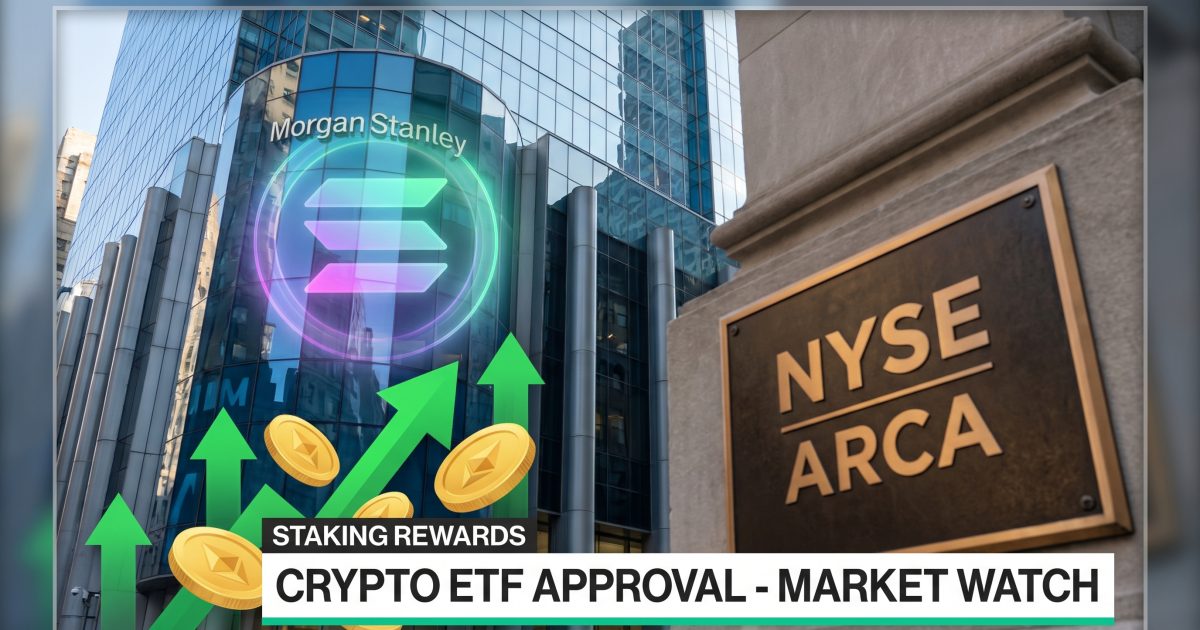
Morgan Stanley has submitted an amended registration statement with the SEC for a spot Solana ETF that includes a staking component — a structural innovation that would generate yield for investors on top of any price appreciation.
The fund, proposed under the ticker MSOL on NYSE Arca, represents Wall Street most ambitious crypto ETF design to date. If approved, it would be the first US exchange-traded product to offer staking rewards as part of its core investment structure.
How MSOL Works
Unlike Bitcoin ETFs, which passively hold an asset that generates no yield, Solana proof-of-stake mechanism allows holders to earn rewards by delegating their tokens to validators who secure the network. Those rewards have historically ranged between 5% and 8% annually.
Morgan Stanley proposal would commit a portion of its SOL holdings to third-party staking providers. The staking rewards would flow back into the fund net asset value, giving MSOL investors a yield component alongside exposure to SOL price movements.
Why This Matters
The MSOL filing represents a significant evolution in crypto ETF design. Every spot crypto ETF approved to date operates as a passive holding vehicle with no income component. MSOL changes that — a 5-7% staking yield on top of SOL price movements creates a fundamentally different value proposition.
Regulatory Hurdles
The SEC has yet to approve any crypto ETF with a staking component, creating regulatory uncertainty for MSOL. Morgan Stanley filing attempts to address these concerns by using third-party, non-affiliated staking providers.
FAQ
How would MSOL staking rewards work? Staking rewards generated by the fund SOL holdings would accrue to the fund net asset value, effectively increasing the value of each share.
When will the SEC decide on MSOL? The SEC has 45 days from the amended filing to review, with potential extensions. A decision could come in Q3 2026.
Would MSOL be available in retirement accounts? Yes. Like other spot crypto ETFs, MSOL would be tradeable in standard brokerage and IRA accounts pending SEC approval.