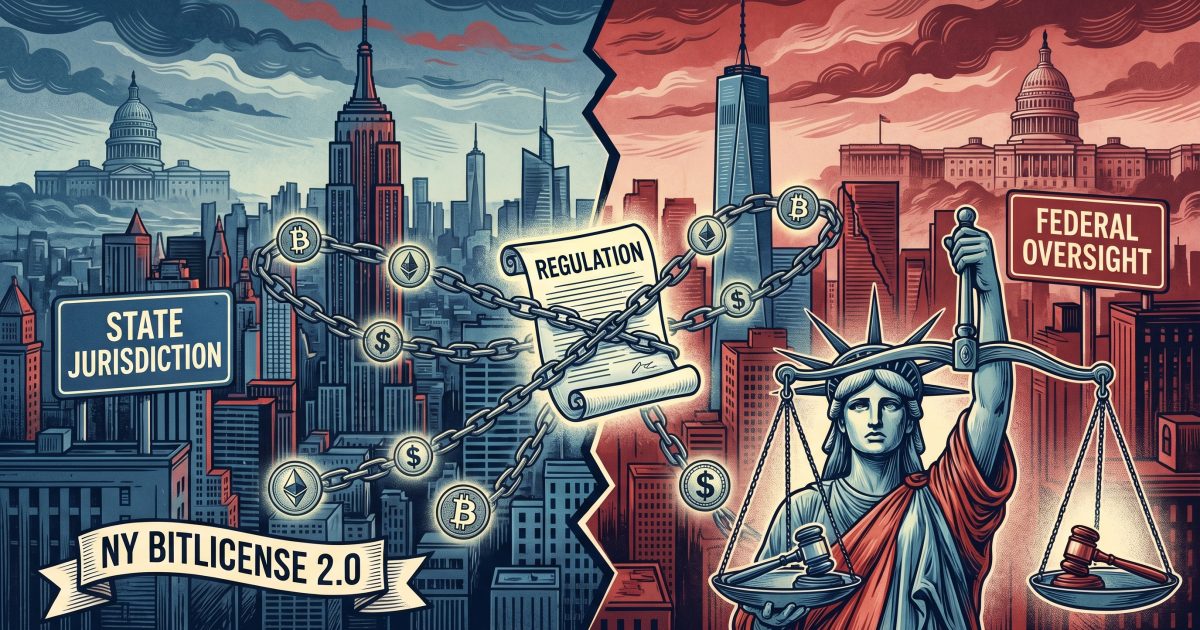

The New York Department of Financial Services (DFS) published proposed new rules for cryptocurrency companies on April 16, significantly expanding the requirements of the state’s BitLicense system. The proposal – informally dubbed “BitLicense 2.0” by the industry – includes stricter capital requirements, mandatory insurance for custodied assets, and detailed disclosure rules for stablecoin reserves.
The timing creates an immediate conflict. The federal government is simultaneously developing its own crypto regulatory system through the Senate’s Clarity Act and the SEC-CFTC interagency classification process. New York’s proposal goes further than the federal approach on several key points, setting up a jurisdictional clash that crypto companies have been dreading.
What the DFS Proposal Includes
The proposed rules cover four main areas:
Capital requirements: Companies holding more than $100 million in customer assets must maintain capital reserves equal to 10% of custodied assets, up from the current unspecified “adequate capital” standard. For a company custodying $10 billion, that means holding $1 billion in liquid capital – a requirement that would strain even large exchanges.
Insurance mandate: All BitLicense holders must carry insurance covering at least 50% of custodied customer assets against theft, hacking, and operational losses. Current requirements only mandate “appropriate” insurance without specifying minimums. The insurance industry has limited capacity for crypto coverage, so this requirement could create a supply crunch.
Stablecoin reserves: Issuers of stablecoins operating in New York must publish monthly attestations of reserve composition, hold 100% of reserves in US Treasuries or cash at FDIC-insured banks, and undergo quarterly audits by Big Four accounting firms. These rules exceed what the federal Clarity Act proposes.
Consumer disclosure: Enhanced risk disclosures for retail customers, including a mandatory “cooling off” period of 24 hours for first-time crypto purchases exceeding $500. The cooling-off provision is new in US financial regulation and has generated the most industry pushback.
The Jurisdictional Collision
Here’s the problem. Federal crypto legislation – when it passes – will establish minimum national standards. New York wants to exceed those minimums, as it does in many other areas of financial regulation. That’s New York’s prerogative as a state regulator. But if federal law preempts state regulation (as the banking lobby wants the Clarity Act to do), New York’s stricter rules become moot.
DFS Superintendent Adrienne Harris explicitly addressed this in the proposal’s preamble: “New York has been the nation’s financial capital for two centuries. Our regulatory standards reflect that responsibility. We won’t defer to a federal system that we believe provides insufficient consumer protection.”
The federal preemption question is live in Congress. The Clarity Act’s current draft includes language that would allow states to maintain stricter rules than the federal minimum – but the banking lobby is pushing to replace that with full federal preemption. If the lobby succeeds, New York’s proposal becomes largely symbolic.
Industry Reaction
The crypto industry’s response has been uniformly negative, though the specific objections vary.
Coinbase, which holds a BitLicense and has its largest US office in New York, called the proposal “well-intentioned but operationally impractical.” The company’s public policy team submitted a 47-page comment letter focusing on the capital requirements, arguing that a 10% capital reserve ratio is “calibrated for banking, not custody” and would force companies to either raise capital or move operations out of New York.
Circle, the USDC issuer headquartered in New York, pushed back on the stablecoin provisions. “We already publish monthly attestations and maintain full reserves in Treasuries and cash,” said Jeremy Allaire. “Mandating Big Four quarterly audits adds significant cost without meaningful additional transparency. And the reserve composition rules are more restrictive than what Europe requires under MiCA.”
Smaller companies are more blunt. “This proposal would make it impossible for startups to operate in New York,” said Alex Mashinsky, who recently launched a new crypto lending platform after the Celsius bankruptcy proceedings concluded. “The capital and insurance requirements are designed for Goldman Sachs, not a 50-person fintech company.”
The Cooling-Off Period Controversy
The 24-hour cooling-off period for first-time purchases has drawn the sharpest criticism. Under the proposal, any new customer making their first crypto purchase above $500 would need to wait 24 hours between placing and confirming the order. The intent is to prevent impulsive buying driven by FOMO or misleading marketing.
The Blockchain Association filed a formal objection, arguing that no other asset class – not stocks, not options, not used ETFs – has a mandatory cooling-off period. “You can walk into a Schwab office and buy $500,000 in used oil futures without a 24-hour wait,” the filing noted. “Singling out cryptocurrency for a cooling-off period is paternalistic and inconsistent with how New York treats other speculative investments.”
Consumer advocates disagree. “Crypto has a unique history of retail harm – rug pulls, exchange collapses, pump-and-dump schemes,” said Dennis Kelleher, CEO of Better Markets. “A 24-hour delay is a modest protection that gives consumers time to reconsider. The industry’s objection tells you everything about its priorities.”
The Historical Context
New York’s original BitLicense, introduced in 2015, was the first state-level crypto licensing system in the US. It was widely criticized at the time as overly burdensome. Dozens of companies left New York rather than comply. The regulation became a cautionary tale about how premature regulation can drive innovation to friendlier jurisdictions.
But the BitLicense also did what it was designed to do: every major exchange operating in New York – Coinbase, Gemini, Robinhood – went through a strict compliance process. When FTX collapsed in November 2022, New York-licensed exchanges were unaffected. The BitLicense created a floor of competence that protected New York consumers.
DFS is now arguing that the floor needs to be raised. The industry is arguing that the floor is already high enough and that federal standards should take precedence.
What Happens Next
The DFS proposal enters a 60-day public comment period ending June 15. After reviewing comments, the DFS can adopt the rules as-is, modify them, or withdraw them. Given the intensity of industry opposition, modifications are likely – the cooling-off period, in particular, seems vulnerable to revision.
The bigger question is whether Congress resolves the preemption issue before New York’s rules take effect. If the Clarity Act passes with state preemption language, the DFS proposal becomes moot. If it passes without preemption, or doesn’t pass at all, New York’s rules become the de facto national standard for any company that wants to serve the state’s 20 million residents.
That’s the use New York has always had. You can leave the state, but you can’t leave the market. For crypto companies that want access to America’s financial capital, New York’s rules matter