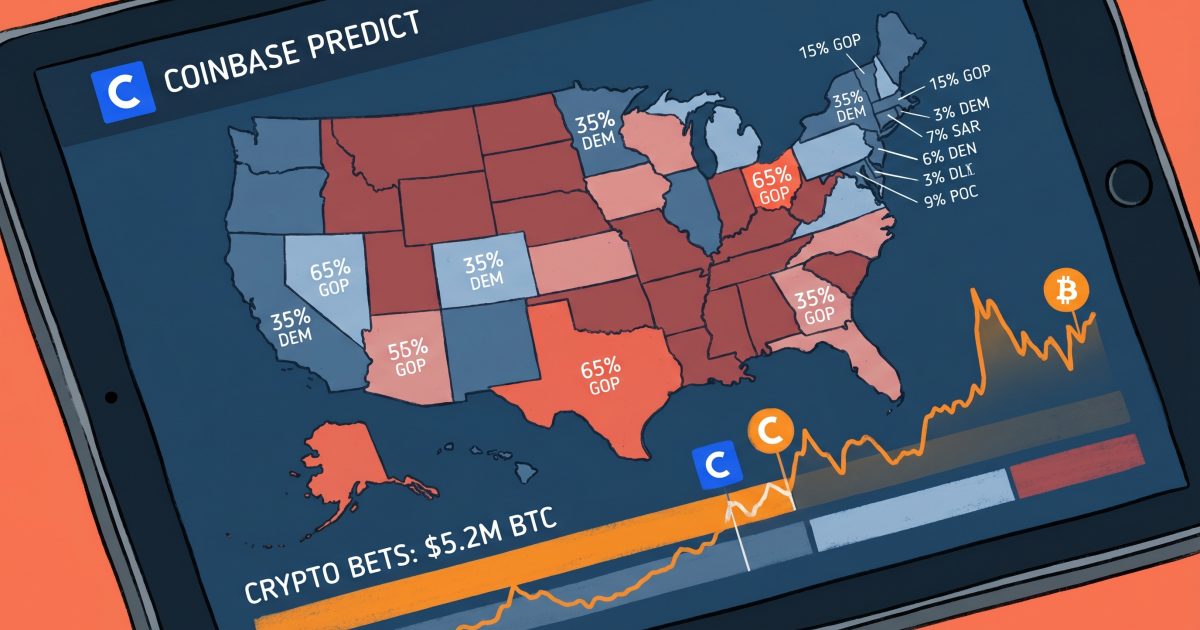

Coinbase quietly rolled out an expanded prediction markets section on its platform this month, adding political, economic, and sports contracts to its existing crypto price prediction markets. The timing is deliberate: the 2026 US midterm election campaign is heating up, and prediction markets are having their mainstream moment.
The expansion puts Coinbase in direct competition with Polymarket, the decentralized prediction platform that became a cultural phenomenon during the 2024 presidential election. But unlike Polymarket – which operates offshore and doesn’t serve US customers directly – Coinbase is a regulated US exchange offering prediction markets to American users through its standard brokerage interface.
What’s Available
Coinbase’s prediction markets currently offer contracts in four categories:
Politics: Binary outcome contracts on US midterm elections. Will Democrats retain the Senate? Will the House flip? Individual seat-level contracts for 20 competitive races. Also available: 2028 presidential nominee contracts for both parties.
Economics: Will the Fed cut rates before July? Will US GDP growth exceed 2.5% in Q2? Will inflation (CPI) stay below 3% through 2026? These contracts settle based on official government data releases.
Crypto: Will Bitcoin hit $100K before June 30? Will Ethereum outperform Bitcoin in Q2? Will the Clarity Act pass the Senate by August? These contracts have been available since February, but the expanded political and economic markets are new.
Sports: Limited to major events – currently NBA playoffs, Champions League, and upcoming FIFA World Cup qualifier markets. Coinbase is treading carefully here due to state-by-state sports betting regulations.
How It Works
Contracts are binary – they resolve to $1.00 if the outcome occurs, $0.00 if it doesn’t. Users buy contracts at the current market price (say $0.63 for “Democrats retain the Senate”), and the price reflects the market’s probability estimate for that outcome. You can buy or sell at any time before the contract expires.
Settlement is in USDC. Coinbase handles the smart contract execution on Base (its own Layer 2 network), with oracle resolution managed by a combination of Chainlink data feeds (for economic data) and a human adjudication panel (for political outcomes).
The minimum trade is $1.00. Maximum position size for political contracts is $25,000 per user – a CFTC-imposed limit under the exchange’s designated contract market (DCM) license.
The Regulatory Backstory
Coinbase obtained a DCM license from the CFTC in late 2025, making it one of only a handful of crypto-native companies authorized to offer event contracts to US retail users. The license came after a two-year regulatory saga that included the CFTC’s initial rejection of Kalshi’s political prediction contracts, followed by a court ruling that forced the CFTC to allow them.
That court ruling, issued in September 2024, established that political event contracts aren’t illegal gambling under the Commodity Exchange Act. The CFTC Then created a system for regulated prediction markets, and Coinbase applied immediately.
“We saw the regulatory window opening and moved fast,” said Paul Grewal, Coinbase’s chief legal officer. “Prediction markets are the next major category of financial products to go on-chain, and we want to be the platform that brings them to the mainstream.”
Competition with Polymarket
Polymarket remains the dominant prediction market by volume, with over $3 billion in total bets placed in 2025. The platform’s advantage is its deep liquidity and global access – anyone with a crypto wallet can participate, and there are no position limits.
But Polymarket doesn’t serve US customers directly (though enforcement of this restriction is minimal). Coinbase’s regulated offering is the first major platform that US users can access legally and easily, through an app they already have installed. The distribution advantage is enormous.
Polymarket’s team isn’t concerned – publicly, at least. “More competition is good. More platforms mean more liquidity, better prices, and more people using prediction markets,” said Shayne Coplan, Polymarket’s founder. “We’ve been building this market for years. We welcome Coinbase to the party.”
Behind the scenes, Polymarket has been exploring ways to serve the US market legally, including a potential partnership with a CFTC-regulated entity. The platform’s offshore model was a regulatory workaround that made sense when prediction markets were in a legal gray zone. Now that the CFTC has created a system, the offshore model is a disadvantage.
Why Prediction Markets Matter
Prediction markets have a track record of outperforming polls, pundits, and models in forecasting political outcomes. During the 2024 election, Polymarket’s prices consistently aligned more closely with the actual results than major polling averages. The market correctly predicted outcomes in 48 of 50 states.
The mechanism is straightforward: when people put real money on an outcome, they’ve an incentive to be accurate rather than tribal. A prediction market doesn’t care about your political affiliation – it cares about your risk assessment. That produces information that polls and pundits can’t match.
For the 2026 midterms, prediction markets offer a real-time barometer of how the political field is shifting. Every policy announcement, scandal, or economic data point gets instantly priced into the contracts. Traders, journalists, and campaign strategists are all watching.
The Midterm Markets
As of April 22, Coinbase’s midterm contracts show:
- Senate control: Democrats 54% / Republicans 46%
- House control: Republicans 61% / Democrats 39%
- Most competitive Senate races: Pennsylvania (D 52%), Wisconsin (D 51%), Ohio (R 54%), Nevada (D 48%)
These prices will shift daily as new polls, fundraising data, and campaign developments emerge. The beauty of prediction markets is that they aggregate information in real time, giving a clearer picture than any single data source.
What’s at Stake for Crypto
Prediction markets are also useful for the crypto industry itself. The Clarity Act contract (“Will the Senate pass stablecoin legislation by August?”) is currently trading at $0.37 – a 37% probability. The ETH staking ETF contract (“Will the SEC approve an ETH ETF with staking by year-end?”) is at $0.28.
These prices give the industry a market-based forecast of regulatory outcomes. They’re more useful than analyst predictions because they represent actual risk-adjusted bets, not opinions. When the Clarity Act contract spikes from $0.37 to $0.55, that’s the market telling you something changed – and it’s telling you before the headlines catch up.
Coinbase’s prediction market expansion is a bet on a future where financial products aren’t just about price exposure – they’re about information. If that bet pays off, prediction markets could become as standard as stock trading on the Coinbase app. The midterms are just the opening act.