Shiba Inu Jumps 36% With No Catalyst as Korean Volume Takes Over
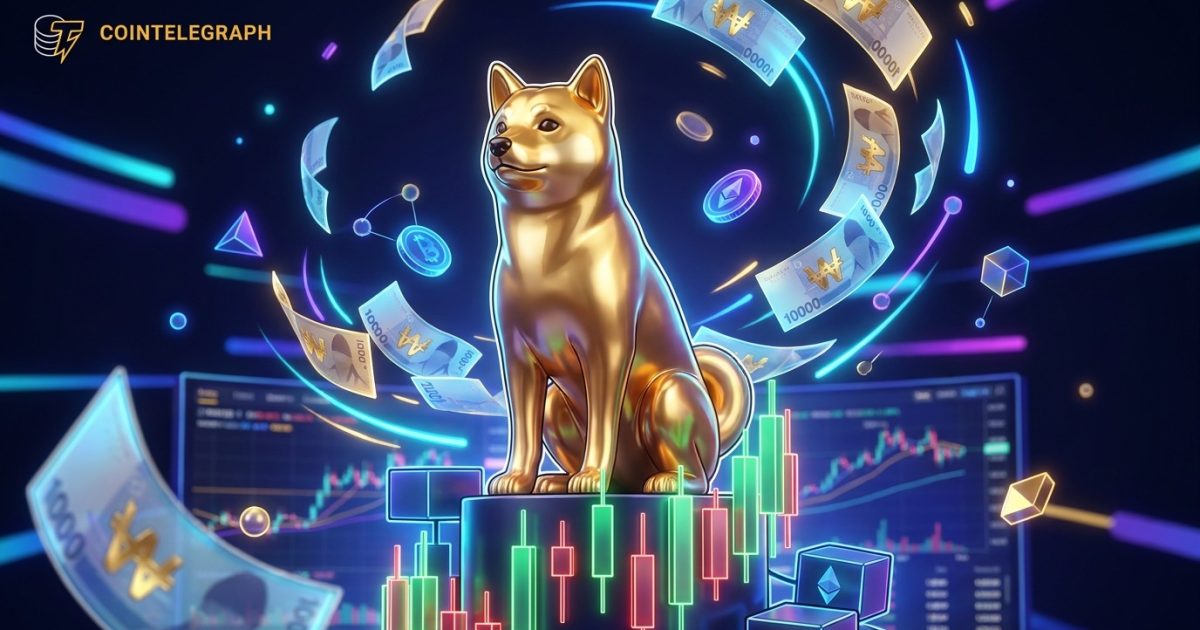
Shiba Inu rose roughly 36 percent to $0.0000057 on Sunday, adding approximately $1 billion in market value over a single day without any discernible fundamental trigger. The memecoin’s market capitalisation now sits near $3.4 billion, supported by almost $380 million in daily trading volume, its highest turnover ranking in months.
The move stands out for its isolation. No announcement has emerged from Shibarium, the project’s layer-2 network. The wider dog-token complex has not kept pace. Dogecoin gained just 6 percent over the same period, and smaller-cap memecoins moved as much as 10 percent, figures that point to something specific to SHIB rather than a broad rotation into joke tokens or a sector-wide risk-on shift.
The token’s price action followed a distinctive two-stage pattern. A first push arrived late Saturday, followed by nine flat hours of consolidation, and then a second leg higher through the Asian morning session. That structure, combined with the volume concentration on a single regional exchange, has led market participants to point to South Korean retail traders as the primary engine behind the rally. The nine-hour pause between legs is consistent with a market that exhausted its first wave of buyers, consolidated, and then found a fresh influx of demand as Asian trading desks opened for the week.
South Korean Traders Carry the Volume
The evidence for Korean dominance is straightforward. Upbit’s SHIB/KRW pair is the single largest market for the token at approximately $62 million in volume, accounting for more than a tenth of global turnover. The pair also trades at a slight premium to Binance and other dollar-denominated venues, a signal that buying pressure is concentrated on the Korean platform rather than distributed across global order books.
South Korean traders have built a reputation for driving exuberant rallies in high-volatility tokens. The country’s retail investor base has historically shown a strong appetite for coins that deliver sharp percentage moves, and SHIB’s climb fits that pattern precisely. The two-stage structure of the rally, with the heavier leg arriving during Asian morning hours, aligns with peak trading activity on Korean exchanges and the typical rhythm of retail-led flows in the region.
The premium on Upbit is particularly telling. When a token trades higher on a Korean exchange than on global dollar pairs, it indicates that local demand is outstripping the supply available through arbitrage. Market makers can only close that gap so quickly, especially for a token like SHIB where the absolute price is minuscule and fractional differences are harder to arbitrage efficiently. The persistence of the premium throughout the rally suggests that Korean buying was not a passing moment but a sustained push that continued through both legs of the move.
This is not the first time Korean venues have anchored a memecoin rally. Historical precedents include sharp moves in XRP and various altcoins where Upbit volume dominated global turnover. The pattern typically involves a sudden surge in local retail interest, often amplified by social media chatter and community-driven momentum, that translates into concentrated buying on a single pair. The question for traders now is whether that Korean demand extends beyond the weekend or whether it represents a short-lived burst of speculative enthusiasm that will fade as the new week begins and liquidity conditions change.
Short Sellers Caught Out, but Liquidations Did Not Cause the Move
Approximately $6 million in SHIB and 1000SHIB positions were liquidated across roughly 2,300 traders during the rally. About $5 million of that total consisted of short positions, meaning traders betting against the token were forced to buy back in as prices rose, adding fuel to the upward move.
However, the timing of these liquidations matters enormously. The heaviest liquidation hour landed squarely on the second leg of the rally, meaning the forced buying came after the initial price jump rather than initiating it. At that scale, roughly $5 million in short liquidations cannot explain a move that added $1 billion in market value. The liquidations amplified the rally’s second leg but did not cause the underlying price appreciation.
This distinction is important for traders trying to assess whether the move has legs. When liquidations are the primary driver, a rally often reverses quickly once the forced buying is exhausted and short positions have been reset. When liquidations follow an organic push, as appears to be the case here, the underlying demand is the variable to watch. If Korean retail interest persists, the token could find further support even after the liquidation tailwind fades. If it does not, the absence of fresh buying will leave prices exposed to a sharp pullback.
The relatively modest size of the liquidation event also underscores how thin the derivatives market for SHIB remains. A $6 million liquidation across 2,300 traders works out to an average position of roughly $2,600, a figure that reflects retail participation rather than institutional positioning. There is no evidence of large players being caught on the wrong side of this move, and no indication that the rally triggered any cascading effects in the broader crypto derivatives market.
A Token Still Searching for Fundamental Grounding
Shiba Inu launched in August 2020 as an Ethereum-based token created by an anonymous developer known as Ryoshi. It was pitched openly as a “Dogecoin killer” with no product behind it. The project has since built out Shibarium, a layer-2 network, and a broader token ecosystem, but SHIB remains far below its 2021 high and trades primarily on retail sentiment rather than anything the ecosystem produces.
The current rally does nothing to change that dynamic. With no announcement from Shibarium, no new product launch, and no evident partnership or development milestone, the price move is untethered from fundamental progress. The token’s market capitalisation of $3.4 billion is supported almost entirely by trading activity and speculative interest, and the rally has not been accompanied by any visible uptick in on-chain metrics that would suggest genuine ecosystem growth.
The lag in the broader dog-token complex reinforces this reading. If the rally were driven by renewed enthusiasm for memecoins as a category, Dogecoin and other similar tokens would be moving in sympathy. Dogecoin’s 6 percent gain and the 10 percent moves in smaller tokens are modest by comparison and suggest that whatever is lifting SHIB is specific to the token’s own trading dynamics on Korean exchanges rather than a sector-wide shift in sentiment toward meme-driven assets.
For ongoing coverage of memecoin market dynamics and retail-driven rallies, see our Bitcoin coverage and related market analysis.
What This Means Going Forward
The SHIB rally is a reminder that memecoins can still generate outsized moves on retail flow alone, particularly when concentrated on a single regional exchange with a demonstrated history of amplifying volatile tokens. The South Korean premium on Upbit is the key signal to watch in the coming days. If it narrows and Upbit volume falls as a share of global turnover, the rally is likely losing steam and a reversion toward previous levels becomes probable. If it holds or widens, Korean demand may continue to drive prices higher in the short term, though the absence of any fundamental catalyst means the move remains inherently fragile.
Regulators in Seoul have previously expressed concern about retail exuberance in crypto markets, and a rally of this nature, with no fundamental backing and concentrated on a single venue, could draw renewed scrutiny. For now, the move stands as a curiosity: a billion-dollar valuation gain driven by buying that no announcement, no product launch, and no broader market trend can adequately explain.