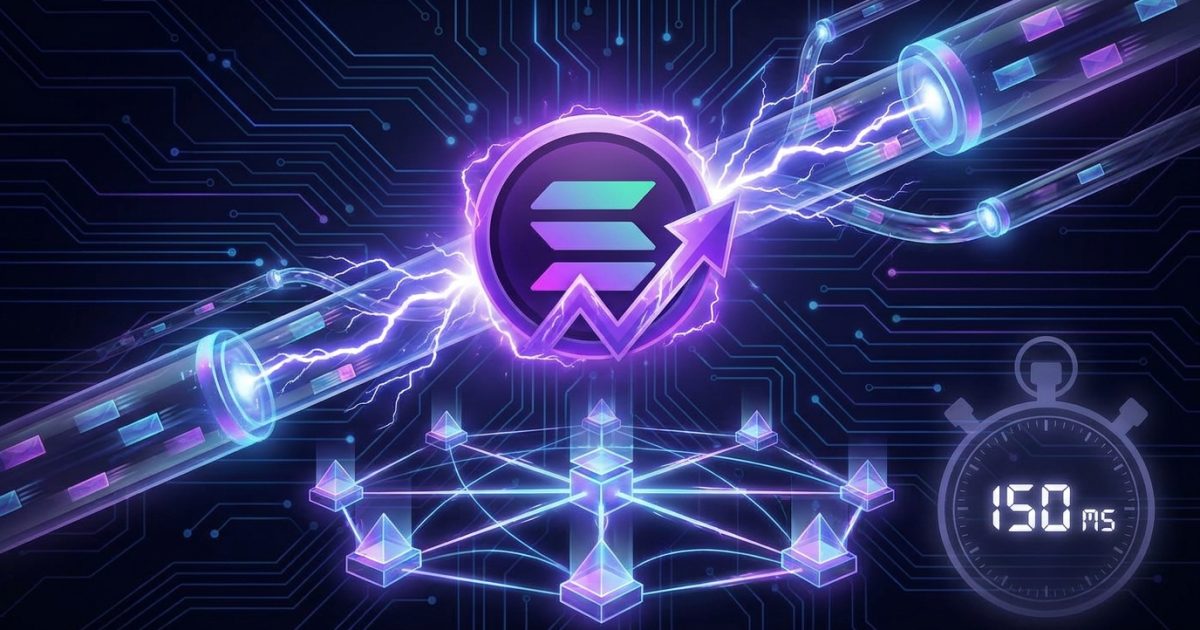
Solana’s most consequential protocol upgrade in the network’s history moved from the research phase to live validator testing on May 11, 2026, when the Alpenglow upgrade activated on a community test cluster. External validator operators are now joining the network and stress-testing a version of Solana that, if successfully deployed to mainnet, would cut block confirmation times to 150 milliseconds — roughly the time it takes a human eye to blink.
The development was announced by Anza, the Solana Labs spinout that has been leading the upgrade’s engineering, and has been watched closely by the Solana validator community and institutional participants who see sub-second finality as a prerequisite for high-frequency payment and trading applications.
What Is Alpenglow?
Alpenglow is not a simple incremental update. It replaces two of Solana’s foundational consensus mechanisms simultaneously: Proof of History (PoH) and TowerBFT.
Proof of History has been part of Solana’s architecture since the network’s inception — it functions as a cryptographic clock, providing a verifiable sequence of events that allows validators to agree on transaction ordering without extensive communication overhead. TowerBFT is the Byzantine Fault Tolerant consensus protocol that uses PoH as a timebase to achieve finality.
Both are being replaced by a new mechanism called Votor, which Anza’s researchers describe as a more efficient approach to consensus that reduces the communication rounds required to achieve finality. The result, according to technical documentation, is a target confirmation time of 150ms — compared to the current typical finality window of several seconds.
75% Block Capacity Boost
Beyond raw speed, Alpenglow also targets a 75% increase in block capacity. Higher throughput combined with faster finality means Solana’s theoretical transaction processing ceiling climbs significantly. While Solana’s marketed 65,000 transactions per second has historically been a peak theoretical figure rather than a real-world sustained throughput number, the Alpenglow improvements are expected to meaningfully expand practical capacity for complex on-chain applications.
“This is the biggest consensus change in Solana’s history,” Anza wrote in its announcement. The community cluster invite went out to validator operators on May 11, and participation has reportedly been strong.
Why 150ms Matters
To understand why 150-millisecond finality is meaningful, consider the use cases that become practical at that speed and impossible at current blockchain speeds.
Payment networks like Visa process transactions with sub-second authorization. Stock exchanges operate on latency measured in microseconds. Solana at 150ms cannot match the fastest traditional financial infrastructure, but it enters a zone where the latency difference becomes imperceptible to end users and where sophisticated financial applications — options markets, high-frequency DEX trading, real-time settlement for cross-border payments — become genuinely viable on-chain.
“150 milliseconds is the threshold where Solana stops being ‘fast for a blockchain’ and starts being ‘fast, period,'” wrote DailyCoin in an analysis of the upgrade’s implications for global finance. “At that speed, the argument that traditional finance needs its own rails becomes much harder to sustain.”
Context: Solana’s Broader Position
The Alpenglow testing comes during a complex period for Solana. The network’s ETFs have posted 19 consecutive days of net inflows, a streak that signals sustained institutional demand. But the network’s total value locked in DeFi has declined from a 2025 peak of $13.1 billion to approximately $5.5 billion, reflecting competitive pressure and some developer migration.
Alpenglow is framed by Solana advocates as the answer to those concerns — a fundamental performance breakthrough that reasserts the network’s edge over both Ethereum and newer Layer-1 competitors. Whether it delivers on that promise depends on a successful transition from testnet to mainnet without the performance regressions or network instability that have plagued past Solana upgrades.
Risks and Timeline
Live validator testing is an important milestone, but it is not mainnet deployment. The Alpenglow upgrade still needs to pass rigorous stress testing on the community cluster, followed by a devnet deployment, and then a mainnet activation vote by the validator community.
Past major Solana upgrades have sometimes taken longer than anticipated to progress through these stages, and the replacement of core consensus mechanisms introduces risks that incremental updates do not. A consensus bug at this layer could, in a worst case, cause validators to produce conflicting blocks or fail to achieve finality — scenarios the Anza team is clearly aware of and testing against aggressively.
The Solana Foundation has not provided an official mainnet activation target date, though community estimates suggest a Q3 2026 deployment is realistic if testing proceeds without major issues.
What Validators Are Saying
Early feedback from validators participating in the community cluster has been broadly positive, according to posts on the Solana validator Discord and X (formerly Twitter). Several large validators have noted that the new Votor consensus mechanism feels smoother under load than TowerBFT, with fewer edge cases triggering validator restarts.
“The finality is genuinely different,” one validator operator with over 100,000 SOL in stake wrote on X. “When I saw the first 150ms confirmation hit the logs, it felt like a completely different network.”
That kind of validator-level enthusiasm matters for mainnet activation. The upgrade requires significant stake-weighted support from the validator set, and early positive testing experiences tend to translate into vote-yes sentiment when the governance decision arrives.
FAQ
What is Solana’s Alpenglow upgrade?
Alpenglow replaces Solana’s Proof of History and TowerBFT consensus mechanisms with a new system called Votor, targeting 150-millisecond block finality and a 75% increase in block capacity.
When will Alpenglow deploy to Solana mainnet?
The upgrade entered live validator community cluster testing on May 11, 2026. A mainnet activation requires further testnet and devnet validation; community estimates suggest Q3 2026 is a realistic target.
Why does 150ms finality matter?
Sub-150ms finality makes real-time on-chain financial applications practical — including high-frequency trading, instant payment settlement, and options markets — by eliminating the latency gap between blockchain and traditional financial infrastructure.
Sources: Anza (via X), TheStreet Crypto, DailyCoin, Coinspeaker, GlobalFinancialMarketReview, crypto.news. Data as of May 2026.