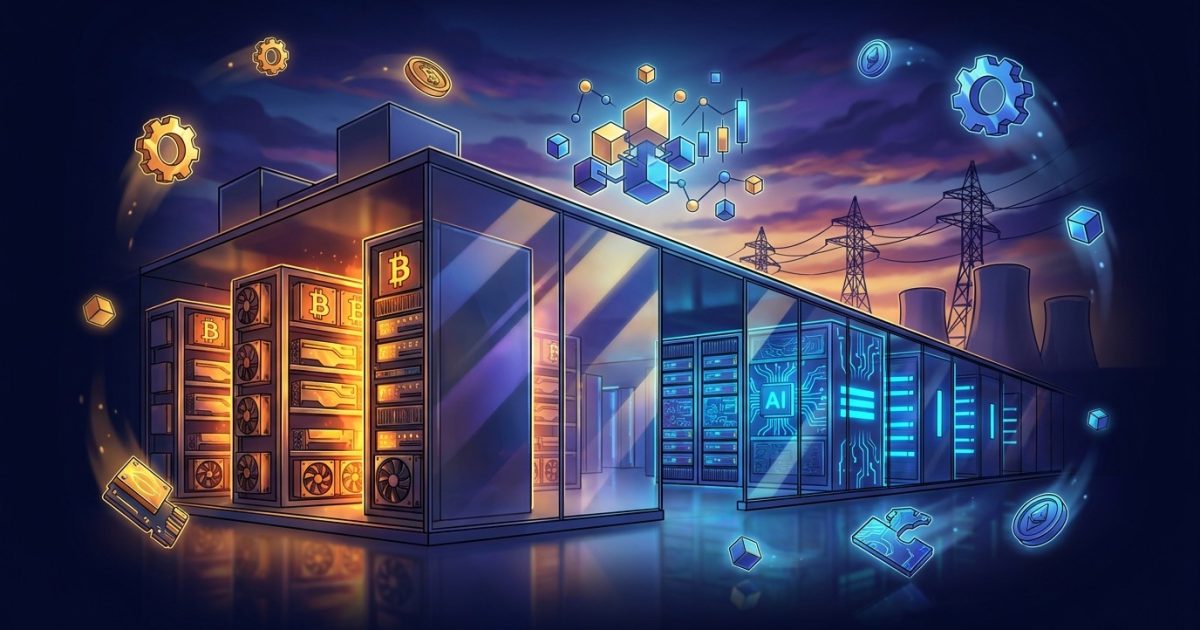
Bitcoin Miner TeraWulf Lands $19 Billion Anthropic Data Centre Lease
Bitcoin mining firm TeraWulf has signed a 20-year data centre lease with artificial intelligence startup Anthropic, a deal expected to generate approximately $19 billion in contracted revenue. The agreement, announced on Monday, represents one of the largest commercial commitments between a cryptocurrency mining operator and an AI developer to date. TeraWulf’s shares responded immediately, climbing more than 10 per cent in early trading following the disclosure.
The scale of the contract is striking. At roughly $950 million per year over two decades, the Anthropic lease alone eclipses the annual revenue figures of many mid-tier bitcoin mining companies. For TeraWulf, a firm that built its business around powering application-specific integrated circuits for bitcoin validation, the deal signals a decisive step toward infrastructure hosting as a primary economic engine rather than a supplementary line of business.
Anthropic, which develops large language models and competes in the increasingly crowded AI assistant market, requires vast amounts of computing power to train and run its systems. The 20-year duration of the lease suggests the startup is making a long-term bet on its own growth trajectory and on the continued availability of dedicated data centre capacity. For TeraWulf, the guaranteed revenue stream provides something that bitcoin mining has never reliably offered: predictability.
The announcement lands at a moment when the bitcoin mining industry is grappling with compressed margins following the April 2024 halving, which reduced block rewards by half. Miners across the sector have been evaluating whether their power-hungry facilities can be repurposed or partially redirected toward AI and high-performance computing workloads, which tend to offer more stable returns. TeraWulf’s deal with Anthropic provides the most concrete evidence yet that this pivot can attract contracts of genuinely transformative size.
The AI Infrastructure Squeeze and Why Miners Hold the Cards
The TeraWulf-Anthropic agreement does not exist in isolation. It reflects a broader infrastructure bottleneck that has intensified as AI development has accelerated over the past two years. Training large language models demands enormous clusters of graphics processing units, and those GPUs require both reliable power and sophisticated cooling systems. The result is what industry observers have described as a chip crunch, with ripple effects extending into memory supply and data centre availability.
Samsung Electronics separately forecast a 19-fold jump in quarterly profit driven by AI demand, while SK Hynix launched a $28 billion US listing. Those figures underscore the sheer capital flowing through the AI supply chain. But the bottleneck is not only at the chip level. The physical infrastructure required to house and power those chips has become a critical constraint, and this is precisely where bitcoin miners find themselves with an unexpected advantage.
Bitcoin mining operations like TeraWulf have spent years securing access to large-scale electricity contracts, building substations, and constructing facilities designed to handle dense arrays of power-hungry hardware. The power densities required for bitcoin mining are not identical to those needed for AI workloads, but the underlying assets, land, power access, cooling infrastructure, and operational expertise, are transferable with appropriate retrofitting. Miners that control sites with substantial megawatt capacity and grid connections are increasingly attractive partners for AI firms that cannot afford to wait years for purpose-built data centres to come online.
The economics of this convergence are compelling. Bitcoin mining revenue is inherently volatile, tied to the price of bitcoin, network difficulty adjustments, and transaction fee dynamics. AI hosting contracts, by contrast, typically involve fixed or escalating lease payments over multi-year horizons. A deal worth $19 billion over 20 years transforms the revenue profile of the hosting miner from speculative to contractual, a shift that has implications not only for the company involved but for how investors value the broader mining sector.
This is not the first time a bitcoin miner has explored AI hosting. Several publicly traded mining firms have disclosed partial redirects of capacity toward high-performance computing. What distinguishes the TeraWulf-Anthropic deal is its magnitude. A $19 billion contracted revenue figure is not a pilot programme or a small-scale diversification experiment. It is a structural commitment that suggests AI developers view mining infrastructure as a viable long-term hosting solution rather than a stopgap measure.
Market Implications for Bitcoin Mining Economics and Valuation
The immediate market reaction, a share price increase of more than 10 per cent in early trading, indicates that investors are beginning to price in the potential for AI hosting to reshape mining company valuations. Traditional bitcoin mining stocks have traded as leveraged proxies for bitcoin price movements, rising and falling with the cryptocurrency market. If a meaningful portion of a miner’s revenue comes from fixed AI leases, the valuation framework shifts toward something closer to an infrastructure or real estate investment trust model, where contracted cash flows matter more than commodity price speculation.
For TeraWulf specifically, the Anthropic deal could lower its cost of capital. Mining firms have historically faced high borrowing costs because their revenue is tied to volatile cryptocurrency markets. A $19 billion contracted revenue stream, assuming the counterparty risk of Anthropic is manageable, provides collateral certainty that lenders and bondholders find far more palatable than bitcoin-denominated mining rewards. That improved access to capital could in turn fund further infrastructure expansion, creating a compounding advantage.
The deal also raises competitive questions for the wider mining sector. Not every bitcoin miner is positioned to pursue AI hosting. The requirements go beyond simply having access to power. AI workloads demand higher reliability standards than bitcoin mining, which can tolerate intermittent interruptions without catastrophic consequences. Data centre clients expect uptime guarantees measured in nines. Facilities must be retrofitted with redundant power systems, advanced cooling, and fibre connectivity that mining operations do not always possess. Miners whose sites are located in remote areas chosen for cheap electricity may find that latency and connectivity constraints limit their appeal to AI tenants.
TeraWulf’s ability to secure the Anthropic contract suggests its infrastructure meets a higher specification than a standard mining site. Competitors will face pressure to demonstrate similar capabilities or risk being left in a purely cryptocurrency-exposed category while the market rerates diversified miners at a premium. This dynamic could accelerate consolidation in the sector, as better-capitalised firms acquire sites with AI-ready potential and smaller operators without the resources to retrofit remain dependent on bitcoin mining alone.
There are also implications for bitcoin network security. If a significant share of mining hash rate is redirected toward AI hosting, the total computational power securing the bitcoin network could plateau or decline. A reduction in hash rate does not immediately threaten bitcoin’s security model, but it does affect mining economics for remaining operators by lowering difficulty and potentially improving profitability for those who stay purely in cryptocurrency. The net effect on network security depends on how many miners follow TeraWulf’s path and how much capacity is ultimately diverted.
Regulatory and Strategic Considerations
The convergence of bitcoin mining and AI infrastructure also invites regulatory attention. Both industries are significant electricity consumers, and policymakers in the United States and elsewhere have increasingly scrutinised the energy footprint of cryptocurrency mining. If mining facilities pivot toward AI hosting, the political calculus may shift. AI development is widely viewed as a strategic priority, and data centre expansion for AI purposes may receive a more favourable regulatory reception than bitcoin mining has experienced. However, the underlying energy consumption remains, and grid operators will need to account for growing demand from facilities that may switch between or simultaneously serve both sectors.
The TeraWulf-Anthropic deal may also prompt questions about market concentration. If a small number of mining firms control the most attractive AI-ready sites, the data centre market could face new competitive dynamics. Anthropic’s willingness to commit to a 20-year lease suggests that available capacity is sufficiently scarce to justify long-term lock-in. Whether other AI developers will seek similar arrangements with mining operators, and at what price points, will determine whether the TeraWulf deal is an outlier or the leading edge of a broader trend.
For more developments on how digital asset firms are adapting to shifting technology landscapes, see our Bitcoin coverage.
Closing Analysis
The TeraWulf-Anthropic agreement marks a defining moment for the bitcoin mining industry’s relationship with artificial intelligence. A $19 billion contracted revenue commitment from a single AI tenant validates the thesis that mining infrastructure can serve as a credible backbone for AI compute at scale. The 10 per cent share price surge reflects market recognition that this is not a marginal diversification story but a potential re-rating event. Whether competitors can replicate the model depends on site quality, capital availability, and the willingness of AI firms to sign long-term leases with operators whose primary identity remains rooted in cryptocurrency. The next several quarters will reveal whether TeraWulf’s deal is the first of many or a singular landmark.