
Meta description: Tether froze $514.64 million in USDT across 370 addresses in a single 30-day period, with 328 wallets on Tron. Stablecoin compliance enforcement is hitting record levels in 2026.
Focus keyword: Tether freezes USDT 514 million wallets 2026
Category: Markets (57)
Slug: tether-freezes-514-million-usdt-370-wallets-30-days-2026
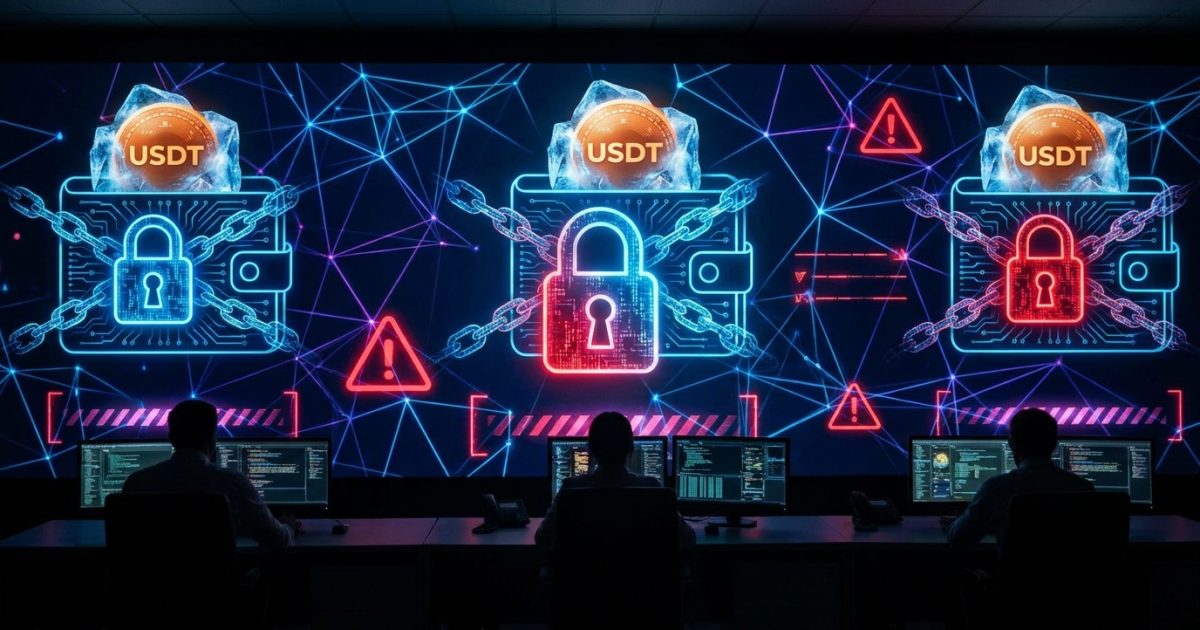
Tether froze $514.64 million in USDT and blacklisted 370 wallets in a single 30-day period ending earlier this month, according to on-chain data published by BlockSec’s USDT Freeze Tracker. The figures represent a record pace of compliance enforcement by the world’s largest stablecoin issuer and mark a dramatic acceleration in collaboration between Tether and global law enforcement agencies.
The breakdown reveals a striking geographic and network concentration: 328 of the 370 blacklisted addresses – approximately 89% – were on the Tron blockchain, with the remaining 42 on Ethereum. Tron has long dominated USDT transaction volume in emerging markets and peer-to-peer transfers, making it the network most commonly associated with sanctioned and illicit flows.
What Tether’s Freeze Powers Actually Mean
When Tether blacklists an address, the USDT tokens held at that address become permanently non-transferable. The tokens aren’t destroyed, but they can’t be moved, sold, or exchanged. From a practical standpoint, the funds are locked indefinitely unless Tether reverses the blacklist – something the company has done historically only in cases of verified errors.
This freeze power is written directly into the USDT smart contract and represents one of the most debated aspects of centralized stablecoin infrastructure. Critics argue it creates a single point of censorship in what’s supposed to be permissionless financial infrastructure. Defenders – including regulators and law enforcement agencies – point to it as exactly the kind of compliance mechanism that allows stablecoins to operate legally within the existing financial system.
The $514 million frozen in 30 days exceeds many quarterly totals from prior years, suggesting either an increase in illicit stablecoin flows, an increase in cooperation between Tether and law enforcement, or both.
Context: Tether’s Growing Law Enforcement Role
Tether’s compliance posture has shifted markedly over the past two years. The company previously drew criticism for slow responses to law enforcement requests and a perceived reluctance to act on documented illicit flows. That active has changed.
In April, Tether froze $344 million in USDT tied to two specific Tron wallets following direct requests from U.S. Law enforcement, a figure that was rolled into the 30-day $514 million total. The company has publicly stated it works with agencies including the FBI, Secret Service, and international law enforcement partners.
Tether CEO Paolo Ardoino has argued that the company’s compliance record – which he claims includes assistance in recovering hundreds of millions of dollars in fraud-related funds – should be viewed as evidence that centralized stablecoins can serve law enforcement without compromising the broader crypto system.
The Tron Question
The concentration of freezes on the Tron network is significant for several reasons. Tron processes an enormous volume of USDT transactions, particularly in markets including Southeast Asia, Latin America, and parts of the Middle East where USDT on Tron is a practical dollar substitute.
Critics have argued that Tron’s architecture and governance structure have historically made it more hospitable to illicit flows than more decentralized networks. The 328 blacklisted Tron addresses in a single month suggests enforcement agencies have developed specific intelligence about Tron-based operations.
Justin Sun, Tron’s founder, has faced U.S. Regulatory scrutiny for unrelated reasons, though Tron the network continues to process hundreds of billions in USDT volume annually.
Implications for Stablecoin Regulation
The enforcement data arrives as the U.S. Senate is simultaneously weighing the GENIUS Act – stablecoin-specific legislation – alongside the broader CLARITY Act. Regulators have repeatedly cited Tether’s freeze power as evidence that stablecoin issuers already possess compliance tools that regulators want formalized into law.
The record pace of enforcement may strengthen the hand of legislators who argue stablecoins can be regulated effectively without a government-issued CBDC. For Tether, the compliance activity simultaneously demonstrates regulatory responsiveness and draws fresh attention to the fundamental tension between censorship resistance and lawful stablecoin operation.
What This Means for USDT Users
For ordinary USDT holders, the freezes serve as a reminder that centralized stablecoin holdings are subject to issuer discretion and law enforcement action. Unlike Bitcoin or decentralized assets where no single party can freeze funds without protocol-level consensus, USDT remains subject to Tether’s compliance function.
The practical risk for law-abiding users is low – Tether’s stated policy is to act only on law enforcement requests or documented fraud. But the scale of the current enforcement wave makes the theoretical risk more concrete.
FAQ
Can Tether freeze my USDT? Yes. Tether’s USDT smart contracts include a blacklist function that allows the company to freeze funds at any address. Tether states it only exercises this power in response to verified law enforcement requests or documented fraud cases. Ordinary users transacting lawfully aren’t targeted, but the technical capability exists for any address.
why’s most frozen USDT on Tron? The Tron blockchain processes a disproportionate share of global USDT volume, particularly in emerging markets. Enforcement agencies have identified a higher concentration of illicit-use addresses on Tron compared to Ethereum. Of the 370 addresses blacklisted in the recent 30-day period, 328 (89%) were on Tron.
Is there a USDT alternative that can’t be frozen? Decentralized stablecoins like DAI (from MakerDAO) and algorithmic or overcollateralized models don’t have a central freeze function. However, they carry different risks including smart contract risk, collateral volatility, and liquidity limitations. No financial product is without tradeoffs.
Sources: BlockSec USDT Freeze Tracker, CryptoTimes, CoinDesk, Coinpaper, The Market Periodical