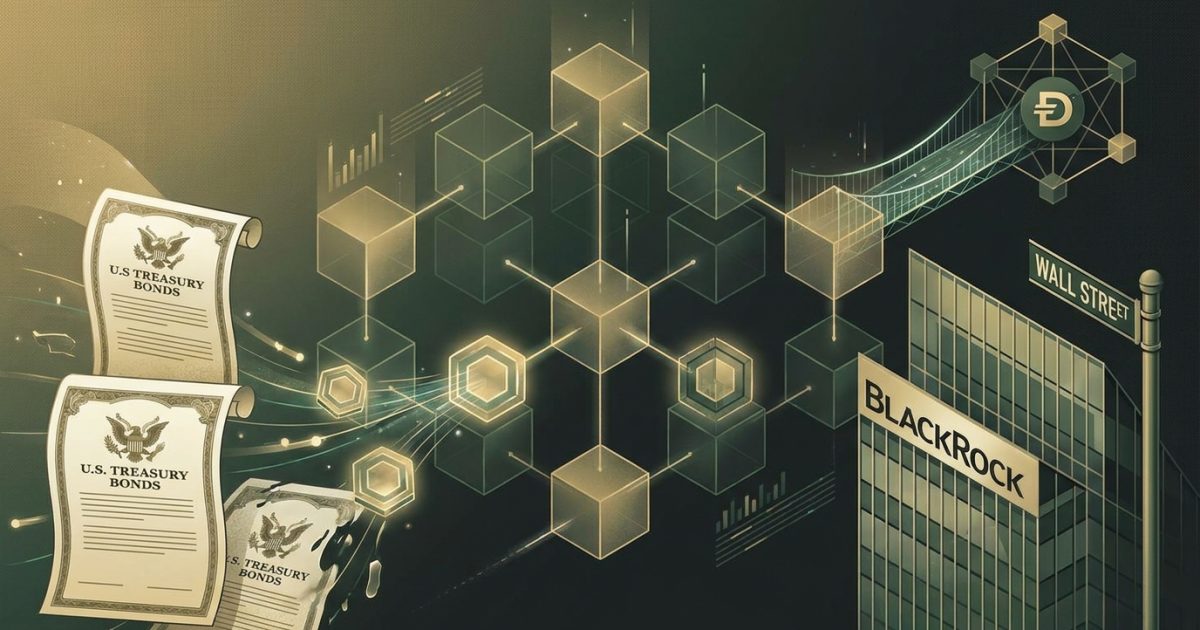
The market for tokenized US Treasury securities has crossed $15 billion in on-chain value, according to data from RWA.xyz — a milestone that marks a turning point in the long-anticipated convergence between traditional fixed income and blockchain infrastructure. The figure sits within a broader tokenized real-world asset market that has surpassed $32 billion in total value, representing growth of over 256% in fifteen months.
BlackRock and JPMorgan are the dominant institutional players driving the expansion, with Franklin Templeton, Ondo Finance, and Superstate also holding significant positions in a market that, twelve months ago, was a fraction of its current size.
Why Tokenized Treasuries Crossed $15 Billion Now
Three converging factors explain the timing and scale of the growth.
Regulatory Clarity: The passage of the GENIUS Act and CLARITY Act in the US, combined with updated SEC guidance on tokenized securities, removed the primary legal uncertainty that had kept institutional capital on the sidelines. Fund managers can now offer tokenized Treasury products to accredited investors and, in some structures, to retail investors through regulated wrappers, without facing ambiguous securities treatment.
Yield Dynamics: With the Federal Reserve maintaining elevated interest rates through early 2026, US Treasuries offered yields of 4.5-5% — attractive enough to make tokenized versions genuinely compelling as collateral and yield-bearing assets in DeFi. Tokenized Treasuries can be deployed as collateral in lending protocols, used for margin on derivatives platforms, and transferred across chains in seconds rather than days. This composability with DeFi infrastructure creates utility that traditional T-bill holdings cannot match.
Infrastructure Maturity: The rails for tokenized securities — custody, compliance, redemption, and cross-chain transfer — have matured to the point where institutional participants are comfortable moving meaningful capital. Securitize, which handles tokenisation and transfer agent functions for BlackRock’s BUIDL fund, has processed billions in redemptions without incident.
BlackRock: The Dominant Player
BlackRock’s BUIDL fund remains the largest single tokenized Treasury product, managing assets that have grown substantially throughout 2026. In May, BlackRock filed two new proposals with the SEC that signal an expansion of its on-chain ambitions: the BlackRock Daily Reinvestment Stablecoin Reserve Vehicle, a tokenized fund designed to back stablecoin reserves, and a second product focused on direct institutional on-chain Treasury access.
The stablecoin reserve application is particularly significant. If approved, it would allow stablecoin issuers to hold BUIDL as reserve backing rather than traditional T-bills held at custodian banks — creating a seamless path from on-chain stablecoin issuance to tokenized Treasury backing. This architecture would deepen the integration between the tokenized securities layer and the DeFi ecosystem considerably.
BlackRock’s dominance in this space is a function of its existing institutional relationships, the scale of its asset management operations, and its early mover advantage in navigating the regulatory process for tokenized securities. Its market share in tokenized Treasuries currently exceeds 30%.
JPMorgan’s On-Chain Expansion
JPMorgan took its tokenization strategy further this month with the launch of JLTXX, its second tokenized money market fund deployed directly on Ethereum. The first fund, the JPMorgan Onyx Digital Assets product, demonstrated that the bank’s institutional clients were willing to hold tokenized money market exposure on-chain; JLTXX represents a product expansion targeting a broader client base.
The bank’s Onyx blockchain infrastructure, which has processed over $1 trillion in repo transactions since its launch, now interfaces directly with Ethereum’s settlement layer for JLTXX. This means institutional clients can hold JLTXX in Ethereum wallets and use it as collateral in DeFi protocols without requiring a conversion step through a traditional custodian.
JPMorgan’s entry into direct on-chain deployment marks a meaningful shift in how the bank characterises its blockchain strategy. Earlier iterations of Onyx treated blockchain as private infrastructure for internal settlement. JLTXX is a public blockchain product, accessible to anyone with a compliant wallet.
The Competitive Landscape: Ondo, Franklin Templeton, Superstate
Beyond BlackRock and JPMorgan, a cohort of crypto-native firms has built significant positions in tokenized Treasuries.
Ondo Finance has emerged as the leading crypto-native player, offering USDY (Ondo US Dollar Yield) and OUSG (Ondo Short-Term US Government Bond Fund) with combined assets exceeding $2 billion. Ondo’s advantage is DeFi integration: its products are designed from the ground up to function as composable on-chain collateral, not just static holdings.
Franklin Templeton pioneered tokenized money market funds with its BENJI product in 2021 and has maintained a strong position as the market has grown. The fund has expanded to multiple blockchains including Ethereum, Polygon, and Stellar.
Superstate operates a Treasury fund as a pure on-chain product, targeting DeFi protocols and crypto-native treasuries as its primary client base. It has grown significantly as DeFi protocols have adopted tokenized Treasuries as treasury assets rather than holding idle stablecoins.
DeFi’s Relationship With Tokenized Treasuries
The most structurally significant development in the tokenized Treasury space is not the headline AUM figure but the integration with DeFi protocols that is now underway.
MakerDAO (now Sky) was among the first major DeFi protocols to allocate substantial treasury assets into tokenized RWAs, reducing its dependence on crypto-native collateral for DAI backing. Aave, Compound, and several newer protocols have since introduced support for tokenized Treasury products as collateral, allowing holders to borrow stablecoins against T-bill exposure.
This integration creates a new yield stack: institutions can hold tokenized Treasuries earning the T-bill rate, use them as collateral to borrow stablecoins at rates below the T-bill yield, and deploy those stablecoins in DeFi strategies that generate additional return. The result is a compounding yield structure that is unavailable through traditional finance channels.
Risks and Regulatory Overhang
The tokenized Treasury market is not without risks. Several are worth flagging.
Redemption liquidity: Tokenized Treasury products typically require redemption requests to be processed through traditional fund infrastructure, which can take one to two business days. In a market stress event where holders need to liquidate quickly, this mismatch between on-chain settlement speed and redemption mechanics could create issues.
Counterparty concentration: BlackRock’s 30%+ market share means the tokenized Treasury market has significant concentration risk. A regulatory action or operational issue affecting a single large provider could have outsized market impact.
Regulatory evolution: The current wave of tokenized Treasury growth has benefited from a regulatory environment that has moved toward clarity. A shift in regulatory posture — particularly in the US or EU — could slow adoption significantly.
Despite these risks, the fundamental thesis — that blockchain infrastructure can make Treasury securities faster, more composable, and more accessible — has now been validated at scale. The $15 billion figure is not a projection; it is reported on-chain value, verifiable in real time on Ethereum and other supported chains.
FAQ
What is a tokenized Treasury and how does it work?
A tokenized Treasury is a digital representation of a US government bond or money market fund held on a blockchain. An asset manager like BlackRock holds the actual Treasury securities and issues digital tokens that represent ownership shares. These tokens can be transferred, used as collateral, or held for yield — all on-chain — without the delays and costs associated with traditional securities transfers.
Can retail investors buy tokenized Treasuries?
Some products are restricted to accredited or institutional investors, but products like Ondo’s USDY and Franklin Templeton’s BENJI have expanded access to a broader investor base. The regulatory treatment varies by jurisdiction.
Is the $15 billion figure the total market or just one provider?
$15 billion refers to the total on-chain value of tokenized US Treasury securities across all providers, as tracked by RWA.xyz. This sits within a broader $32 billion tokenized real-world asset market that also includes other asset classes like private credit and real estate.
Sources: RWA.xyz, Investax, CryptoTimes, Intellectia.ai, MEXC