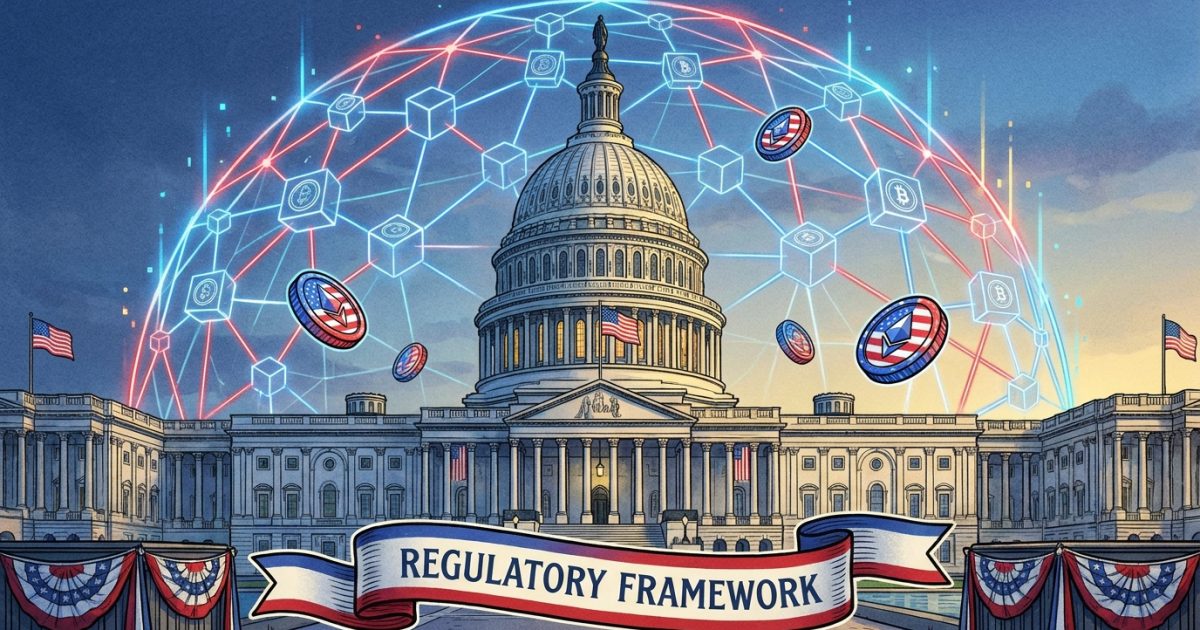
The White House has set an Independence Day deadline for one of the most consequential pieces of crypto legislation in American history. Patrick Witt, executive director of the President’s Council of Advisors for Digital Assets, told an audience at Consensus Miami 2026 on Wednesday that the administration is targeting July 4, 2026 for Congress to pass the Digital Asset Market Clarity Act – the sweeping bill that would establish the United States’ first complete system for digital asset markets.
The announcement, made on stage at the industry’s largest annual conference, was met with a mix of optimism and cautious skepticism by attendees. July 4 is less than two months away. The legislative clock is ticking.
What the CLARITY Act Does
The Digital Asset Market Clarity Act – also referred to as the Clarity Act or DAMA – is the market structure counterpart to the GENIUS Act, which was signed into law earlier this year and established a federal system for stablecoins.
Where the GENIUS Act addressed stablecoins, the Clarity Act tackles the broader question of how digital assets are classified and regulated. It draws a clear jurisdictional line between the Securities and Exchange Commission (SEC) and the Commodity Futures Trading Commission (CFTC), ending years of regulatory ambiguity that has been a major obstacle for institutional adoption.
Under the bill’s system:
- Digital assets that function as commodities (including Bitcoin and, depending on circumstances, Ethereum) would fall under CFTC oversight.
- Digital assets that function as securities – typically tokens issued by centralized projects with the expectation of profit from the efforts of others – would remain under SEC jurisdiction.
- A new “digital commodity” classification would be created for assets that don’t fit cleanly into either existing category, with tailored registration and disclosure requirements.
For the industry, clarity on these classifications is arguably more important than any price movement. It would allow exchanges, brokers, and institutional investors to build compliant products with legal certainty – something the current environment of enforcement-by-lawsuit has made nearly impossible.
The Legislative Timeline
Witt acknowledged at Consensus that the path to July 4 is ambitious but achievable. He pointed to the bipartisan support that helped the GENIUS Act pass as evidence that Congress is willing to move on crypto legislation when the political conditions align.
“What we’ve seen is a lot of good progress over the last year,” Witt told the Consensus audience. “The GENIUS Act showed us what’s possible when you get the right stakeholders in the room and the right political will.”
The House has already passed a version of the Clarity Act with a bipartisan majority. The Senate version has been working through committee, with the most recent reports indicating that key sticking points – including the treatment of proof-of-work mining operations and the classification threshold for “decentralized” protocols – are close to resolution.
Witt indicated that the White House is actively engaged in Senate negotiations and views July 4 not as a firm deadline but as a “symbolic and achievable” target that the administration is genuinely working toward.
Tether Warns: The 2026 Midterms Could Undo Everything
The push to pass the Clarity Act before July 4 takes on added urgency given warnings from industry veterans about the political risks that lie ahead.
Also speaking at Consensus Miami, Jesse Spiro, Head of Government Affairs at Tether, delivered a sobering message to the assembled industry executives: the November 2026 midterm elections could have a “seismic impact” on crypto’s legislative gains.
“We’ve made extraordinary progress,” Spiro said. “But everything we’ve built legislatively can be undone if the political composition of Congress changes in November. Getting the Clarity Act done before the midterms isn’t just a policy priority – it’s a political important.”
Spiro pointed out that while crypto has become a bipartisan issue in some respects – with both parties competing for the votes of the estimated 52 million American crypto holders – the eniasm isn’t uniformly distributed across all congressional seats up for election. A shift in congressional majority could produce a leadership change on the key committees that oversee financial services and digital assets.
What Passage Would Mean for Markets
The immediate market impact of the Clarity Act passing would likely be significant, though the magnitude is debated.
On the optimistic end, proponents argue that regulatory clarity would get a wave of institutional capital that has been waiting on the sidelines. Index funds tracking digital assets, sovereign wealth fund allocations, pension fund exposure – all of these are contingent on a clear legal system that the Clarity Act would provide.
On the cautious end, analysts note that markets often “buy the rumor and sell the news.” Much of the regulatory optimism may already be priced into crypto assets given the broader policy shift under the current administration. Passage could trigger a relief rally rather than a sustained bull run.
The most widely cited outcome is that the Clarity Act would accelerate the approval of additional crypto financial products – spot ETFs for assets beyond Bitcoin and Ethereum, crypto derivatives on regulated exchanges, and institutional lending products – over a 12-24 month window following passage.
The Road From Here
The next six weeks will be consequential. Senate Majority Leadership will need to schedule floor time for the bill, and any last-minute amendments that require a conference committee process could push the timeline past the July 4 target.
The crypto industry isn’t leaving the outcome to chance. Lobby groups including the Blockchain Association, the Chamber of Digital Commerce, and Stand With Crypto have all mobilized significant resources for the final legislative push. Coinbase, which has spent hundreds of millions of dollars on lobbying and political donations over the past two years, has positioned the Clarity Act as its top 2026 priority.
“This is the most important piece of financial legislation in a generation for this industry,” a senior Coinbase policy official said in a statement ahead of Consensus. “we’re in the final mile.”
FAQ
what’s the Digital Asset Market Clarity Act? The Digital Asset Market Clarity Act is a complete US legislation that would establish clear regulatory frameworks for digital assets, dividing oversight between the SEC (securities) and the CFTC (commodities). it’s considered the market structure companion to the GENIUS Act, which addressed stablecoins.
When could the Clarity Act become law? The White House is targeting July 4, 2026 for passage by Congress. The House has already passed a version of the bill with bipartisan support. Senate negotiations are ongoing, with the key outstanding issues reportedly close to resolution.
Why does the Clarity Act matter for crypto prices? If passed, the Clarity Act would remove the regulatory uncertainty that has kept many institutional investors on the sidelines. Clearer jurisdictional rules would enable more institutional products, index fund inclusions, and sovereign wealth fund allocations – all potentially significant sources of demand for Bitcoin and other digital assets.