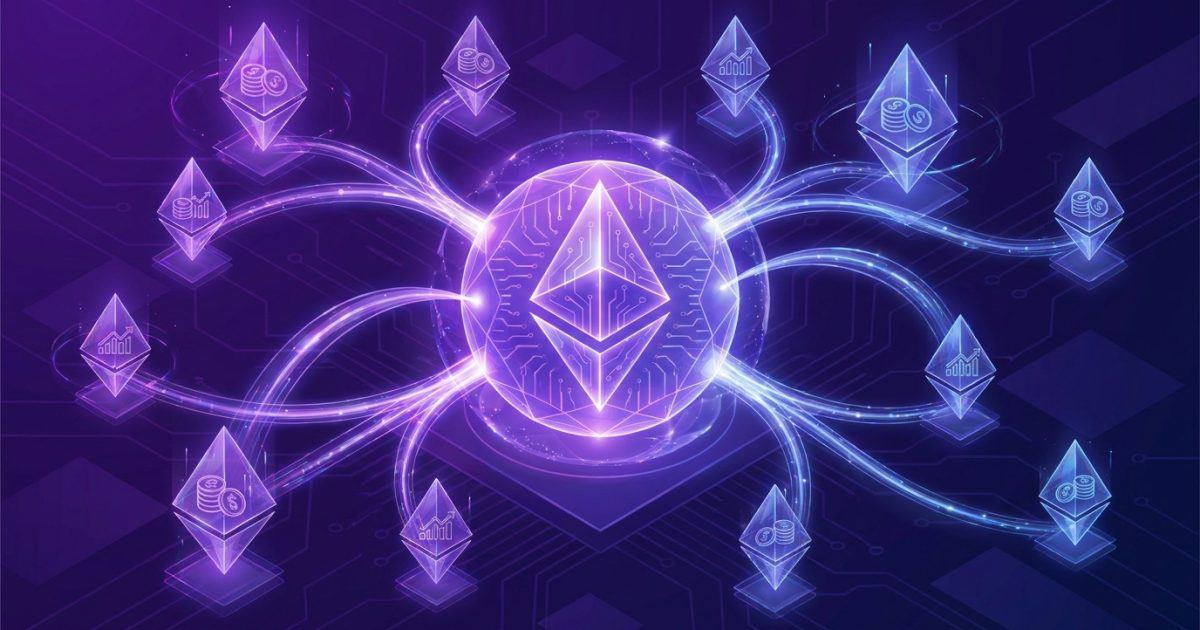

Aave’s fourth major protocol version launched on Ethereum mainnet at the end of March, introducing a modular hub-and-spoke architecture designed to separate institutional and retail lending pools. The upgrade, which Aave Labs has called its most significant since the protocol’s inception, arrives at a critical moment for decentralized finance as the sector recovers from the $292 million KelpDAO exploit.
What Aave V4 Actually Changes
The hub-and-spoke model replaces V3’s unified liquidity pool with a modular structure where different lending markets operate as independent “spokes” connected to a central hub. Each spoke can have its own risk parameters, collateral requirements, and liquidation thresholds, allowing the protocol to serve dramatically different user profiles without commingling risk.
For institutional lenders, this means isolated pools with KYC-compliant counterparties, conservative collateral ratios, and the kind of risk isolation that compliance teams demand. For retail DeFi users, the existing permissionless lending experience continues in separate spokes with their own parameters.
The architecture also introduces what Aave Labs calls “soft isolation,” where a failure in one spoke can’t cascade into others. This is a direct response to the systemic risk lessons learned from the KelpDAO exploit, which exposed how interconnected DeFi protocols could propagate losses across the system.
The $25 Million Development Push
The upgrade was funded by a $25 million allocation from the Aave DAO, approved on April 13 to support ongoing V4 development and deployment across additional chains. The funding covers smart contract auditing, cross-chain deployment infrastructure, and the creation of specialized spokes for emerging use cases like real-world asset (RWA) lending.
Aave Labs secured the funding after presenting evidence that V4’s architecture could capture institutional capital that has been sitting on the sidelines. The DAO governance vote passed with over 92 percent approval, reflecting strong community consensus that the protocol’s survival depends on attracting more conservative capital sources.
Timing Is Everything
V4’s launch coincides with a turbulent period for DeFi. The KelpDAO exploit, which drained $292 million through a bridge vulnerability, sent shockwaves through the lending sector. Aave was directly affected, having raised $160 million through its DeFi United fund to cover bad debts from the incident.
Against this backdrop, V4’s risk isolation features take on added urgency. The exploit demonstrated that a single bridge failure could propagate across multiple protocols, wiping out billions in TVL. V4’s spoke architecture is designed to contain such contagion by ensuring that institutional pools are never exposed to the same bridge or oracle infrastructure as higher-risk retail pools.
Total value locked across DeFi has partially recovered from the $13 billion TVL wipeout that followed the KelpDAO incident, but remains well below pre-exploit levels. Aave’s bet is that V4’s institutional-grade risk management will help rebuild confidence faster than simply patching V3.
Institutional Interest Is Building
The institutional spoke has already attracted significant attention. Morgan Stanley’s recently launched Stablecoin Reserves Portfolio (MSNXX), which manages reserves for stablecoin issuers under the GENIUS Act, has reportedly explored integration with Aave V4’s institutional lending pools as a yield source for idle reserves.
Traditional finance firms are increasingly comfortable with DeFi protocols that can demonstrate risk isolation, regulatory compliance, and transparent governance. V4’s architecture checks all three boxes, at least on paper. Whether it performs under real-world stress will be the defining test.
Chainlink’s integration with V4 provides oracle infrastructure, following its recent SOC 2 Type 2 certification from Deloitte, a credential that makes institutional compliance teams significantly more comfortable with on-chain data feeds.
The Technical Details
V4 introduces several technical innovations beyond the hub-and-spoke model:
Granular risk parameters: Each spoke can set independent loan-to-value ratios, liquidation thresholds, interest rate curves, and collateral types. Governance can adjust individual spokes without affecting the rest of the protocol.
Enhanced liquidation engine: A new auction-based liquidation system replaces the fixed-discount model, allowing liquidators to compete for the right to close undercollateralized positions. This should result in better prices for borrowers and more efficient clearing.
Cross-chain messaging: V4 includes native support for cross-chain spoke deployment, meaning the same hub can coordinate lending pools on Ethereum, Arbitrum, Optimism, and other chains from a single governance system.
Risk oracles: A new risk oracle layer allows third-party risk providers to feed real-time risk scores directly into the protocol, enabling dynamic parameter adjustments based on market conditions.
Competition Heats Up
Aave V4 doesn’t operate in a vacuum. Compound III, MakerDAO’s Spark Protocol, and newer entrants like Morpho are all competing for the same institutional DeFi market. Each takes a slightly different approach to risk isolation and institutional access.
Aave’s advantage is scale. With over $12 billion in TVL across all versions, the protocol has the deepest liquidity and the most extensive integration network. V4’s challenge is maintaining that scale while splitting it into isolated pools that may individually offer less depth than V3’s unified market.
The race to become the institutional DeFi lending standard is arguably the most consequential competition in the sector right now. The winner won’t just capture institutional capital. They’ll help define what institutional DeFi looks like for the next decade.
FAQ
What is Aave V4’s hub-and-spoke architecture?
V4 replaces the unified liquidity pool with a modular system where separate lending markets (spokes) connect to a central hub. Each spoke has independent risk parameters, preventing failures in one pool from cascading to others.
How does V4 address the KelpDAO exploit risk?
V4 introduces soft isolation between spokes, ensuring that institutional pools are never exposed to the same bridge or oracle infrastructure as higher-risk pools. A failure in one spoke can’t propagate to others.
When did Aave V4 launch?
Aave V4 launched on Ethereum mainnet on March 30, 2026, with cross-chain deployment to Arbitrum and Optimism planned for Q2 2026.