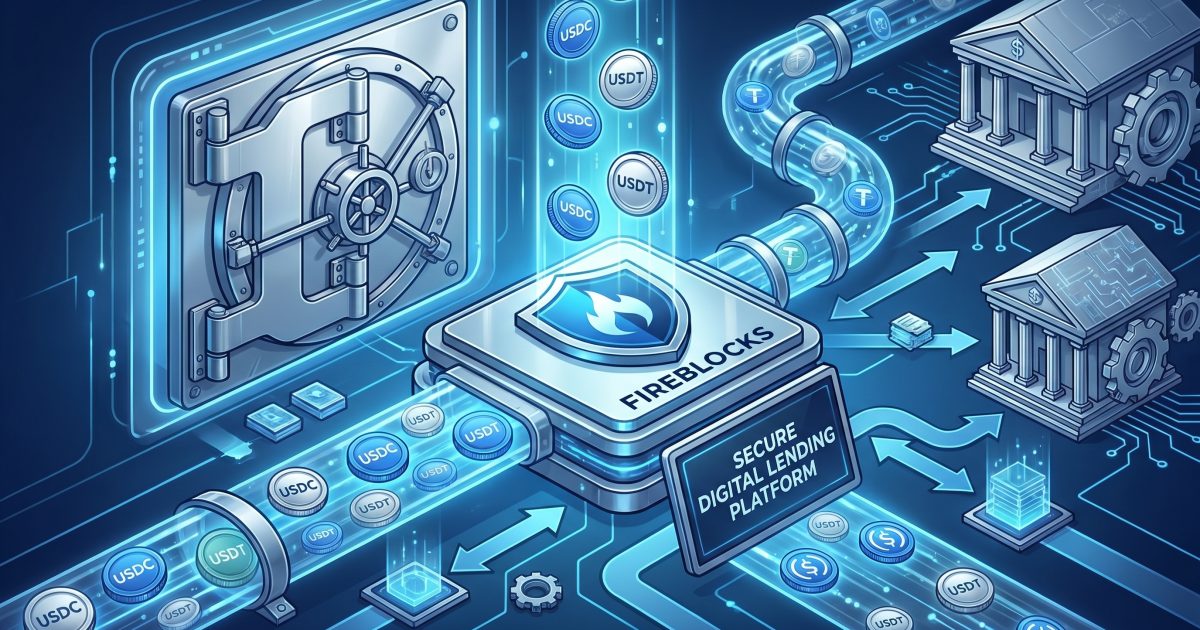

Fireblocks, the digital asset infrastructure company valued at $8 billion, has launched a dedicated stablecoin lending platform aimed at institutional participants. The service, called Fireblocks Lend, went live on April 21 with $400 million in committed lending capacity from eight institutional lenders, including two unnamed US banks.
The platform allows qualified institutions to borrow and lend USDC and USDT at negotiated rates, with all assets custodied within Fireblocks’ existing infrastructure. Collateral management, margin calls, and settlement are automated through smart contracts, but the credit decisions are handled by traditional underwriting – not algorithmic lending.
It’s a hybrid model: crypto rails, bank-grade risk management.
How It Works
Fireblocks Lend operates as a bilateral marketplace. Lenders – typically asset managers, corporate treasuries, or banks – deposit stablecoins into the platform and set their lending terms: minimum rate, maximum duration, acceptable collateral types. Borrowers – primarily crypto funds, market makers, and trading firms – post collateral (BTC, ETH, or other approved assets) and borrow stablecoins against it.
The collateralization ratios are conservative by DeFi standards. The minimum loan-to-value ratio is 65%, with automatic margin calls at 75% and liquidation at 85%. By comparison, DeFi lending protocols like Aave typically allow LTVs up to 80-85% before liquidation.
“We deliberately set tighter parameters than DeFi,” said Michael Shaulov, Fireblocks CEO. “Our clients are institutions that can’t afford the liquidation cascades you see on-chain. They need predictability, and they need a human in the loop on credit decisions.”
Settlement occurs on-chain but within Fireblocks’ infrastructure, meaning both parties need Fireblocks accounts. This closed-loop design eliminates the smart contract risk that comes with public DeFi lending – there’s no external attack surface because the contracts are internal to Fireblocks’ secure environment.
Why Now
The timing reflects a market gap that’s been growing for two years. Since the collapse of centralized lending platforms in 2022 – Genesis, BlockFi, Celsius, Voyager – the institutional crypto lending market has been underserved. DeFi protocols filled part of the gap for on-chain lending, but many institutions can’t or won’t use DeFi directly due to compliance, counterparty risk, and operational complexity.
Meanwhile, stablecoin supply has grown to $317 billion, and a significant portion sits idle in wallets earning nothing. Corporate treasuries that hold stablecoins for payment or settlement purposes want yield on those holdings, but the options are limited to DeFi (too risky for most compliance teams) or OTC desks (opaque and manual).
“There’s $50 billion in stablecoins sitting in institutional wallets earning zero,” said Shaulov. “That’s the market we’re going after. These are treasurers who want 4-5% on their USDC but won’t touch Aave.”
The Competitive Field
Fireblocks isn’t the only company targeting institutional stablecoin lending. Galaxy Digital launched a similar service in late 2025. Maple Finance has been running institutional lending pools for over a year. Ondo Finance and Mountain Protocol are building yield products on top of stablecoins backed by T-bills.
What differentiates Fireblocks is distribution. The company already serves over 1,800 institutional clients across its custody, trading, and settlement products. Fireblocks Lend plugs directly into that existing client base. A hedge fund that already uses Fireblocks for custody can enable lending with a few clicks – no new onboarding, no new compliance review.
“Fireblocks’ advantage is that it’s already the plumbing for institutional crypto,” said Alex Thorn, head of research at Galaxy Digital. “Adding lending on top of that’s a natural extension. The question is whether they can attract the lender side – the banks and asset managers – at scale.”
The Risk Factors
Institutional stablecoin lending carries risks that the platform’s design can mitigate but not eliminate.
Credit risk: If a borrower’s collateral drops in value faster than the margin call cycle can respond, lenders take a loss. Fireblocks mitigates this with conservative LTV ratios and real-time monitoring, but crypto’s volatility means rapid drawdowns are always possible.
Stablecoin risk: The platform depends on USDC and USDT maintaining their pegs. A depeg event – like USDC’s brief deviation during the Silicon Valley Bank crisis in March 2023 – would create chaos in the lending market. Fireblocks doesn’t control this risk; it can only set exposure limits.
Regulatory risk: If stablecoin regulation requires lending platforms to obtain banking licenses, Fireblocks would need to adjust its model. The company has proactively registered with FinCEN and obtained money transmitter licenses in key US states, but the regulatory field is still evolving.
What This Means for the Market
Fireblocks Lend is another brick in the wall between traditional finance and crypto coming down. Banks lending stablecoins through a custody platform. Hedge funds borrowing digital dollars against Bitcoin collateral. Treasury departments earning yield on their crypto holdings through institutional-grade infrastructure.
None of this is new in isolation. Traditional lending has existed for centuries. What’s new is the asset type and the rails. Stablecoins move 24/7, settle in minutes, and can be collateralized programmatically. That creates efficiencies that traditional lending can’t match, which is why banks are interested despite crypto’s reputational baggage.
The $400 million in initial committed capacity is modest. But if Fireblocks Lend demonstrates that institutional stablecoin lending can operate without blow-ups for a few quarters, expect that number to grow rapidly. The institutional demand is there. The infrastructure was the missing piece, and Fireblocks just built it.