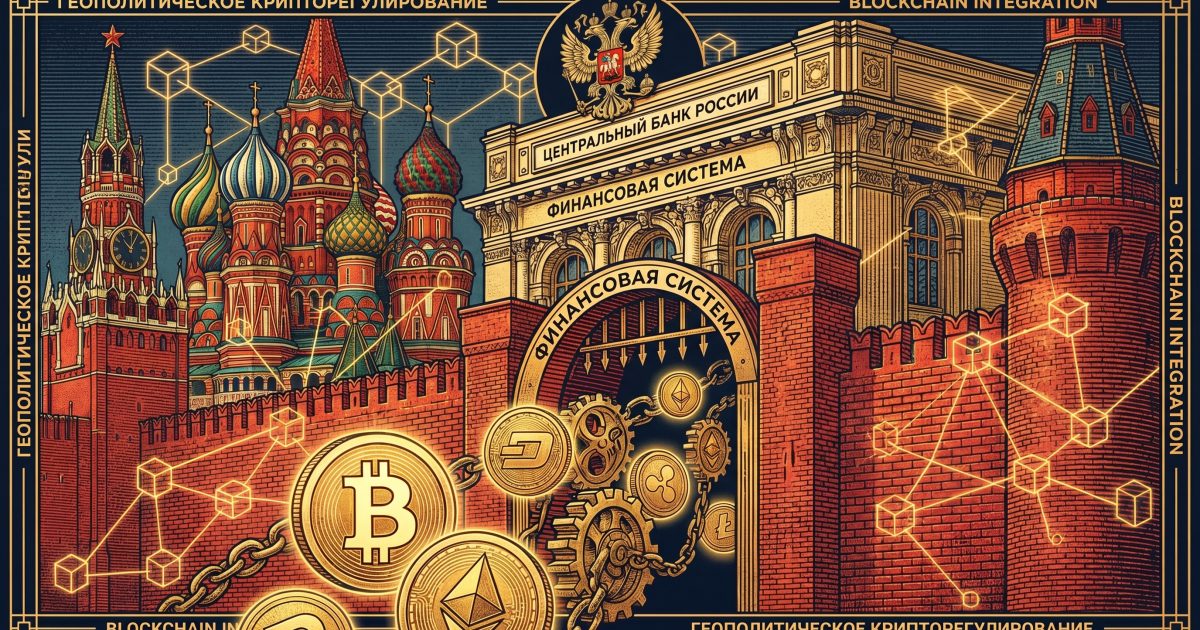

Russia’s State Duma passed a bill on April 17 that formally integrates cryptocurrency into the country’s financial regulatory system. The legislation, which President Putin is expected to sign within weeks, places all crypto-related activities – mining, trading, custody, and exchange – under the oversight of the Central Bank of Russia (CBR).
This isn’t a surprise. Russia has been moving toward crypto formalization for over a year, driven by two forces: the need to tax a growing domestic mining industry, and the desire to use digital assets as a tool for sanctions evasion. The bill attempts to accomplish both while maintaining the CBR’s control over capital flows.
What the Bill Does
The legislation creates three categories of regulated crypto activity:
Mining: All mining operations must register with the CBR and report hash rate, energy consumption, and revenue. Miners must sell at least 50% of mined crypto through licensed Russian exchanges or convert it to rubles through authorized banks. The tax rate on mining income is set at 13% for individuals and 20% for corporations – aligning with Russia’s standard income tax brackets.
Trading: Russian citizens can trade cryptocurrency on licensed exchanges, with annual reporting requirements for holdings exceeding 600,000 rubles (approximately $6,500). Exchanges operating in Russia must obtain a CBR license, set up KYC/AML procedures, and maintain ruble on/off ramps. Foreign exchanges that don’t comply will be blocked at the ISP level.
Institutional use: Russian banks and financial institutions can hold and transact in cryptocurrency for settlement purposes, subject to CBR approval. This is the most significant provision – it effectively allows Russian banks to use crypto for cross-border payments, a capability that Western sanctions have made increasingly attractive.
The Sanctions Angle
Let’s not dance around it. A primary motivation for this bill is sanctions circumvention. Since 2022, Russia has been progressively cut off from the SWIFT payment system, Western banking networks, and dollar-denominated trade. Crypto offers an alternative channel, and formalizing it gives the Russian government more control over how that channel operates.
The bill includes a provision allowing the CBR to authorize “special purpose digital asset transactions” for entities engaged in foreign trade. The language is deliberately vague, but the implication is clear: Russian exporters of oil, gas, and commodities can use cryptocurrency to receive payment from counterparties in sanctioned trade corridors – particularly China, India, and the Middle East.
The US Treasury’s Office of Foreign Assets Control (OFAC) issued a statement on April 19 warning that “the use of digital assets to evade US sanctions is subject to enforcement action regardless of the jurisdiction in which the transaction occurs.” The warning was widely read as a direct response to the Russian bill.
Russia’s Mining Industry
Russia is the world’s second-largest Bitcoin mining country after the United States, with an estimated 12% of global hash rate. The industry is concentrated in Siberia, the Urals, and Irkutsk Oblast, where cheap hydroelectric power makes mining economically attractive.
The mining sector has operated in a legal gray zone since 2020. Miners paid taxes voluntarily (or didn’t), and the government couldn’t accurately measure the industry’s size or revenue. The new bill changes that by requiring registration and mandatory reporting.
Russian mining operators have responded cautiously. BitRiver, the country’s largest hosting provider, said it “welcomes regulatory clarity” but expressed concern about the 50% forced-sale requirement. “Miners should have the freedom to hold or sell their bitcoin based on market conditions, not government mandates,” said BitRiver CEO Igor Runets.
Impact on Global Crypto Markets
The bill’s immediate market impact was minimal – Bitcoin barely moved on the news. But the longer-term implications are significant.
If Russia successfully uses crypto for sanctions-busting trade, it validates the use case that Western regulators fear most. That could trigger a regulatory backlash in the US and EU, with stricter enforcement against mixers, privacy coins, and unhosted wallets. It could also accelerate the development of blockchain surveillance tools, as Western intelligence agencies invest in tracking Russian crypto flows.
Conversely, Russia’s formalization of crypto adds another major economy to the list of countries with clear regulatory frameworks. Along with the EU (MiCA), UAE, Singapore, and Japan, Russia’s bill contributes to a global trend toward regulation rather than prohibition.
What China Is Watching
China banned crypto trading and mining in 2021, but Beijing is closely monitoring Russia’s approach. If Russia demonstrates that formalized crypto regulation can serve geopolitical objectives – sanctions evasion, alternative payment rails, tax revenue from mining – China may reconsider its blanket ban, at least for institutional and cross-border use cases.
Several Chinese analysts have publicly noted that Russia’s bill could create a competitive disadvantage for China in digital asset innovation. Whether that pressure is enough to shift Beijing’s stance remains to be seen, but the conversation is happening.
The Uncomfortable Truth
Russia’s crypto bill highlights a tension at the heart of decentralized finance. The same properties that make crypto useful – permissionless transfers, censorship resistance, global accessibility – also make it useful for actors that the Western financial system is trying to isolate.
Crypto can’t be both a tool for financial freedom and a tool exclusively for the “right” kind of financial freedom. Russia’s bill is a reminder that decentralized technology serves whoever uses it, and the geopolitical consequences of that neutrality are only beginning to be felt.