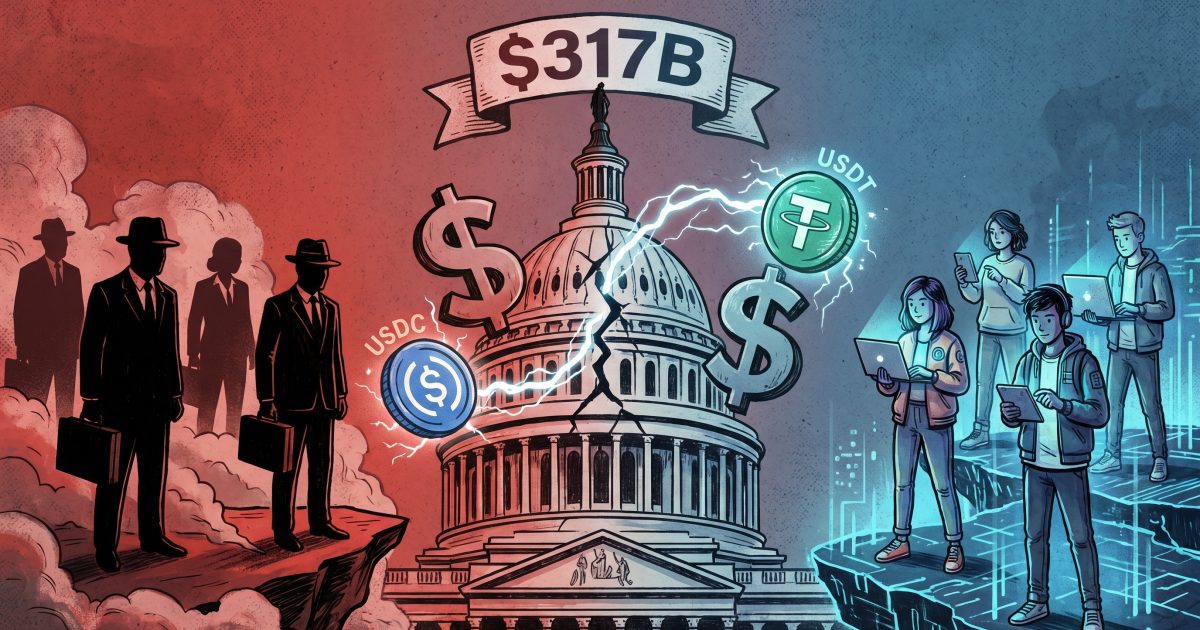

The Senate Banking Committee is scheduled to mark up the Clarity for Payment Stablecoins Act on April 28, and the lobbying war around it has reached a pitch not seen since the Dodd-Frank era. At stake: who gets to issue the digital dollars that underpin a $317 billion market – and whether that privilege stays open to crypto-native companies or gets locked behind a banking charter.
The bill, introduced by Senators Hagerty and Gillibrand, would create a federal licensing system for stablecoin issuers. Non-bank companies like Circle and Tether could register as “payment stablecoin issuers” under the Federal Reserve’s oversight, provided they meet reserve requirements, submit to audits, and maintain capital buffers.
Banks hate it.
What the Banks Want
The American Bankers Association, the Bank Policy Institute, and the Financial Services Forum have jointly lobbied against the bill’s non-bank issuer provisions. Their argument: allowing non-bank entities to issue dollar-denominated payment instruments creates systemic risk and undermines the regulated banking system.
In a letter to committee members obtained by CryptoGazette, the ABA wrote: “Payment stablecoins are functionally identical to deposits. Entities that issue them should be subject to the same prudential requirements as banks, including FDIC insurance, use ratios, and Community Reinvestment Act obligations.”
Translation: if Circle wants to issue USDC, it should become a bank. And becoming a bank means accepting a regulatory burden that would fundamentally change Circle’s business model and cost structure.
The bank lobby has spent over $14 million on stablecoin-related lobbying since January, according to OpenSecrets data. That’s on top of the $174 million the banking industry spent on federal lobbying overall in 2025.
What the Crypto Industry Wants
Circle, Tether, and the crypto trade groups – including the Blockchain Association, the Digital Chamber, and Stand With Crypto – are pushing hard for the bill as written. Their position: stablecoins aren’t deposits. They’re payment instruments backed by actual reserves, not fractional-reserve lending. Forcing them into a banking system would kill innovation and hand the market to offshore issuers.
Jeremy Allaire, Circle’s CEO, has been making the rounds on Capitol Hill. “The Clarity Act strikes the right balance. It protects consumers, ensures reserve transparency, and keeps the US competitive. The alternative – forcing everyone into bank charters – would just push issuance offshore, which is worse for everyone.”
Allaire has a point. Tether, the largest stablecoin issuer, is already incorporated in the British Virgin Islands with operations in El Salvador. If US regulation becomes too restrictive, Tether simply continues operating from jurisdictions that welcome it, while US companies either comply with bank-level costs or exit the market.
The Political Fault Lines
The bill has bipartisan support in principle, but the details are contested. Senate Banking Committee Chair Tim Scott wants the bill to pass before the August recess, giving the committee just three months to resolve outstanding disagreements.
The main friction points:
- State vs. federal authority: Several senators want to preserve the ability of state regulators to license stablecoin issuers, as New York already does through its BitLicense system. The banking lobby wants federal preemption – one federal license, no state alternatives.
- Reserve composition: The current bill allows reserves in US Treasuries, cash at Federal Reserve master accounts, and Fed reverse repos. Banks want to add a requirement for FDIC-equivalent insurance on reserves, which would effectively force issuers to partner with banks.
- Foreign issuers: Tether’s offshore structure is the elephant in the room. The bill as written would require foreign issuers to register with the Fed if they want their stablecoins to be “recognized” for US use. Tether has said it would comply but hasn’t indicated how.
Why $317 Billion Matters
Stablecoins now process more transaction volume than Visa. In 2025, stablecoin transfers totaled over $12.4 trillion, up from $7.7 trillion in 2024. Most of that volume is in USDT and USDC, used for cross-border payments, DeFi trading, and increasingly, real-world commerce in developing markets.
The total supply of stablecoins hit $317 billion in April 2026. That’s real money sitting in real reserves – mostly US Treasury bills. The stablecoin market is now the 18th largest holder of US government debt, ahead of countries like Saudi Arabia and South Korea.
Banks see this as both a threat and an opportunity. If stablecoin issuers are regulated as banks, the existing banking system absorbs a $317 billion market and its associated fee revenue. If they’re not, a parallel payment system continues to grow outside traditional banking infrastructure.
What Happens at Markup
The April 28 markup will be the first real test of whether the bill can survive in its current form. Expect at least three categories of amendments: bank-lobby-backed amendments that would tighten the definition of eligible issuers, crypto-friendly amendments that would expand state-level authority, and bipartisan tweaks to the foreign issuer provisions.
If the bill passes committee with its non-bank issuer system intact, it goes to the full Senate with real momentum. If the banking lobby succeeds in gutting the non-bank provisions, the crypto industry has signaled it would rather have no bill than a bank-only bill – and we’re back to regulatory limbo.
The Clarity Act is the most consequential piece of crypto legislation since the Infrastructure Investment and Jobs Act stuck a broker reporting requirement into a highway spending bill in 2021. The difference is that this time, both sides are paying attention. And both sides have brought their checkbooks.