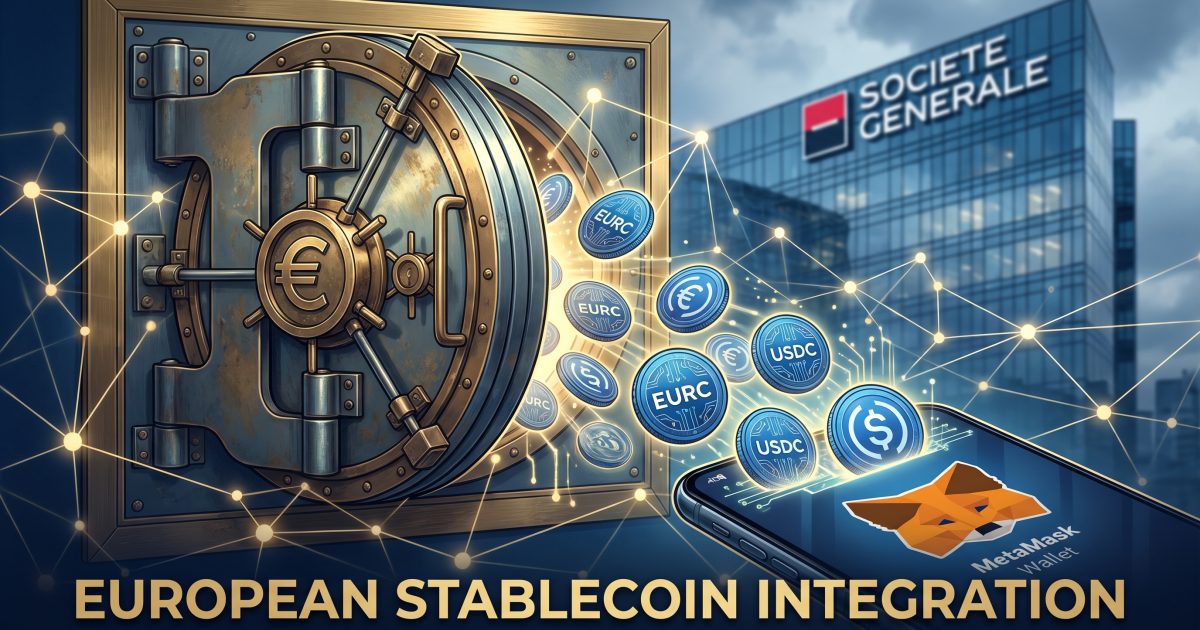

Societe Generale’s digital asset subsidiary, SG-FORGE, has struck a partnership with Consensys to make its USD-denominated stablecoin, USDCV, available directly through MetaMask. The integration, announced April 20, lets MetaMask’s 30 million monthly active users buy and hold a stablecoin issued by one of Europe’s largest banks – directly from their self-custody wallet.
This is the first time a top-tier European bank has plugged a proprietary stablecoin into a major Web3 wallet. It’s also a signal that the stablecoin war isn’t just Tether versus Circle anymore. Traditional banks are entering the field, and they’re doing it through crypto-native infrastructure.
What Is USDCV?
USDCV is a USD-pegged stablecoin issued by SG-FORGE on Ethereum. It launched quietly in late 2025, initially available only to institutional clients and verified counterparties. The coin is fully backed by US Treasury bills and cash equivalents held in segregated accounts at Societe Generale’s New York branch.
SG-FORGE also issues EURCV, a euro-denominated stablecoin that has been circulating since mid-2024. The euro version has accumulated roughly $120 million in circulation, mostly used in institutional settlement and trade finance.
USDCV’s reserve structure mirrors what Circle does with USDC, but with one key difference: the issuer is a bank regulated by the European Central Bank and France’s ACPR. That gives USDCV regulatory cover under MiCA, the European Union’s crypto asset regulation that came into full force in 2025.
The MetaMask Integration
Through the Consensys partnership, MetaMask users can purchase USDCV directly within the wallet using a bank transfer or card payment. The coin is minted on-chain in real time and deposited to the user’s Ethereum address. Redemptions work in reverse – burn the token, receive USD to a linked bank account within one business day.
Joe Lubin, founder of Consensys and co-founder of Ethereum, framed the deal as a milestone. “This is what we’ve been building toward for a decade. A regulated European bank issuing digital dollars that anyone with a MetaMask wallet can hold, spend, and transfer permissionlessly.”
The integration also includes a fiat off-ramp, meaning MetaMask users can sell USDCV back to fiat without leaving the wallet interface. That’s a direct competitor to the on/off-ramp services provided by MoonPay, Transak, and other payment processors that MetaMask currently integrates.
Why This Matters for the Stablecoin Market
The global stablecoin market sits at around $230 billion, with Tether’s USDT commanding roughly 60% and Circle’s USDC holding about 25%. Everyone else – including PayPal’s PYUSD, Ripple’s RLUSD, and various smaller issuers – fights over the remaining 15%.
Societe Generale isn’t trying to compete with Tether on volume. They’re competing on trust and compliance. MiCA is tightening the rules on stablecoin issuers, and where the US Senate is debating its own stablecoin legislation, being a fully regulated bank gives SG-FORGE an advantage with institutional users, payment companies, and corporate treasuries that need regulatory certainty.
“The next phase of stablecoin adoption isn’t driven by DeFi degens – it’s driven by CFOs who need to explain their treasury strategy to a board of directors,” said Kalin Nicolov, head of digital assets at Citi. “Bank-issued stablecoins solve the trust problem that keeps those CFOs up at night.”
What Consensys Gets
For Consensys, the deal diversifies MetaMask’s revenue beyond swap fees and gas facilitation. The company earns a revenue share on USDCV minting and redemption flows processed through the wallet. Given MetaMask’s massive user base, even modest adoption could generate meaningful transaction volume.
It also positions MetaMask as more than a crypto wallet – it becomes a bridge between traditional banking and decentralized finance. If a Societe Generale client can mint stablecoins in MetaMask, they can also provide liquidity on Aave, trade on Uniswap, or earn yield on Lido. The bank becomes an on-ramp to the entire Ethereum system.
Competitive Pressure
Societe Generale isn’t the only bank eyeing this field. Deutsche Bank is developing a euro stablecoin through its Taurus partnership. JPMorgan has been running its JPM Coin for institutional settlement since 2023. HSBC tokenized gold on a private chain last year.
But none of those products are available in a self-custody wallet. SG-FORGE is the first major bank to cross that line – putting a bank-issued asset in a permissionless environment where the user controls the keys.
That’s a philosophical shift. Banks have spent years building “blockchain” products on permissioned networks they control. SG-FORGE is saying: we’ll issue on public Ethereum, let anyone hold it, and compete on the merits of our reserve management and regulatory standing.
The Bigger Picture
Five years ago, the idea of a European megabank issuing stablecoins inside MetaMask would have sounded absurd. Banks wanted nothing to do with crypto wallets, and crypto wallets wanted nothing to do with banks.
That mutual suspicion is dissolving, driven by regulation (MiCA forced banks to take stablecoins seriously), market demand (corporate treasurers want dollar-denominated digital assets from trusted issuers), and competitive pressure (if you don’t build it, your rivals will).
SG-FORGE’s USDCV won’t dethrone Tether. It doesn’t need to. If it captures even 1-2% of the stablecoin market among institutional and corporate users, that’s $2-4 billion in AUM and a powerful new distribution channel for Societe Generale’s digital asset strategy. And with MetaMask as the front end, it has a direct line to the retail market too.