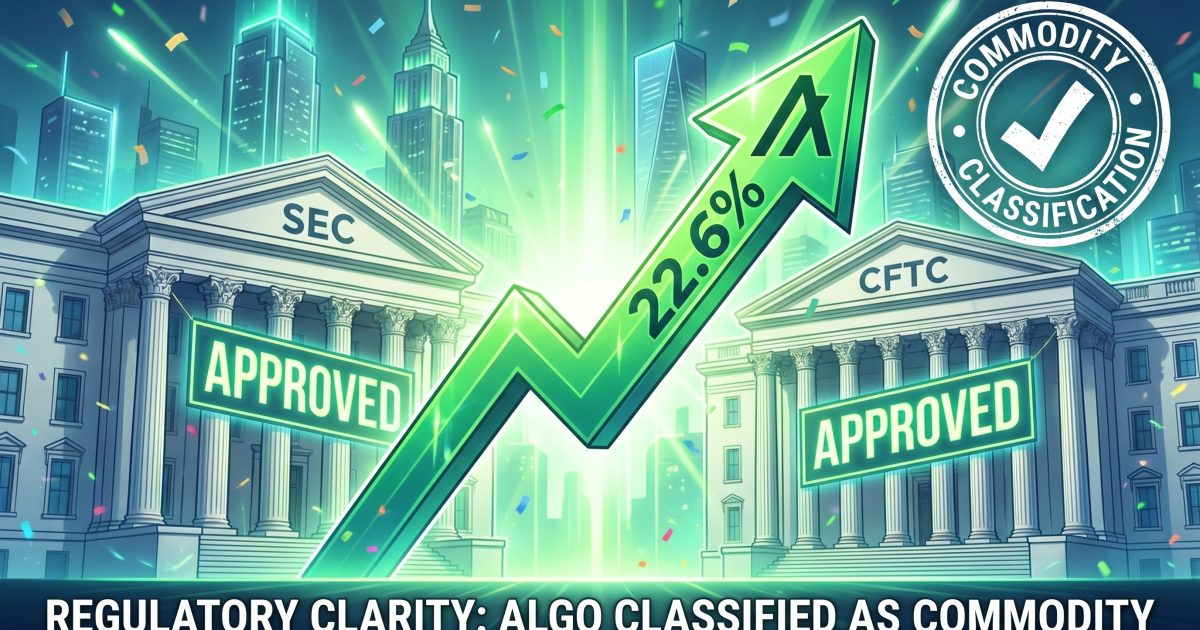

Algorand’s native token ALGO surged 22.6% on April 19, rocketing from $0.41 to $0.503 after a joint statement from the SEC and CFTC classified it as a commodity rather than a security. The determination, issued under the agencies’ new interagency coordination system, makes Algorand only the fourth cryptocurrency to receive a formal commodity classification – after Bitcoin, Ethereum, and Litecoin.
The rally extended through the weekend, with ALGO touching $0.54 on Sunday before settling around $0.51. Trading volume on Coinbase and Binance spiked to $890 million in 24 hours – roughly 15 times the token’s average daily volume.
What the Classification Means
The commodity designation means ALGO falls under the CFTC’s regulatory purview rather than the SEC’s. In practical terms, this means:
- No securities registration required: Exchanges can list and trade ALGO without concerns about offering an unregistered security.
- Futures and derivatives access: Regulated US derivatives exchanges (CME, CBOE) can offer ALGO futures and options without SEC approval.
- Institutional comfort: Fund managers and RIAs that are restricted from holding securities-classified crypto can now allocate to ALGO under their commodity mandates.
- Staking clarity: Staking ALGO isn’t subject to Howey test analysis, removing the legal ambiguity that has plagued staking services since the SEC’s enforcement actions against Kraken and Coinbase in 2023.
The joint statement cited three factors in the determination: Algorand’s proof-of-stake consensus mechanism is “sufficiently decentralized” that no single entity controls block production; the Algorand Foundation’s role has evolved from a development entity to a grants and research body with limited operational control; and ALGO’s primary utility is as a payment and staking token within a functioning network, not an investment contract.
The Interagency System
This classification came through a new process established by the SEC and CFTC in January 2026. After years of turf wars between the agencies – each claiming jurisdiction over different aspects of the crypto market – the current SEC Chair and CFTC Chair agreed to a joint review process for determining whether specific tokens are securities or commodities.
The system involves a 90-day review period during which both agencies assess a token’s technical architecture, governance structure, economic model, and market behavior. The Algorand determination is the first to emerge from this process, and it’s being watched closely as a template for future classifications.
“This is what the industry has been asking for – a clear, predictable process for determining regulatory status,” said Perianne Boring, founder of the Digital Chamber. “Algorand applied for review in January, and four months later, they’ve an answer. That’s how regulation should work.”
Which Tokens Are Next?
Multiple token projects have submitted applications under the new system. Market participants expect Solana, Avalanche, and Polkadot to be among the next tokens reviewed. XRP, which settled its long-running SEC lawsuit in 2025, already has de facto clarity but hasn’t received a formal commodity classification under the new system.
The classification criteria favor tokens with high decentralization, limited foundation control, and clear utility beyond speculative investment. Tokens where a single entity controls more than 20% of supply or has significant governance power are likely to face a tougher review.
Solana’s review is expected to be the most consequential. SOL is the fifth-largest cryptocurrency by market cap, and its classification would either open the door to institutional products (futures, ETFs) or maintain the regulatory ambiguity that has kept some institutional investors on the sidelines.
Algorand’s Fundamentals
The price surge is partly regulatory relief and partly a re-evaluation of Algorand’s position in the market. The network has been quietly building institutional infrastructure while the spotlight focused on Solana and Ethereum.
Key metrics: Algorand processes roughly 7,000 transactions per second with finality under 4 seconds. The network has 12.4 million active accounts, up 34% year-over-year. Total value locked in Algorand DeFi sits at $890 million, concentrated in lending protocol Folks Finance and DEX Tinyman.
The network has also gained traction in real-world asset tokenization. Several European and Middle Eastern institutions use Algorand for tokenized bond issuance and trade settlement. FIFA continues to use the network for its digital collectibles platform, and the government of Italy’s digital bond pilot runs on Algorand infrastructure.
Market Implications
ALGO’s 22.6% jump demonstrates the regulatory premium that exists in crypto markets. Tokens with clear regulatory status trade at a significant premium to those in legal limbo. If the SEC-CFTC system continues to produce commodity classifications for credible projects, expect similar pops for each new determination.
The broader implication is that the US is moving from a regime of enforcement-based regulation – where the SEC sues first and classifies later – to one of proactive classification. That shift benefits the entire industry, even tokens that ultimately receive securities classifications, because at least the rules become predictable.
For ALGO specifically, the commodity classification opens the door to a spot ETF application, futures trading on regulated exchanges, and inclusion in institutional crypto indexes. Whether the Algorand system can capitalize on that opening depends on execution – but the regulatory barrier is now gone.
As one trader on X put it: “ALGO just got the golden ticket. Now they need to build Willy Wonka’s factory.”