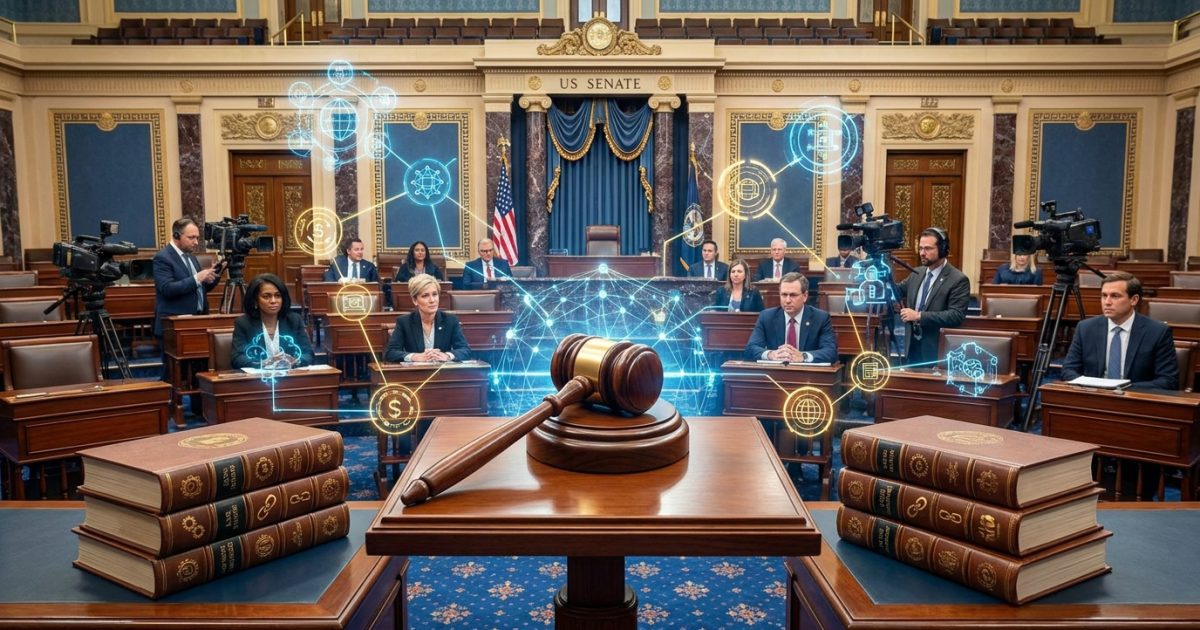
CLARITY Act Passes Senate Banking Committee 15-9 – Crypto’s Biggest Regulatory Test Moves to the Full Senate
Meta description: The CLARITY Act cleared the Senate Banking Committee in a 15-9 vote, advancing crypto’s most sweeping regulatory system yet toward a full Senate floor vote. Focus keyword: CLARITY Act Senate vote crypto regulation
Crypto’s most consequential piece of legislation in years cleared a major hurdle on May 14, 2026. The CLARITY Act passed the Senate Banking Committee with a 15-9 vote, advancing what would become the first complete regulatory system for digital assets ever enacted by the United States Congress.
The vote follows months of contentious back-and-forth between crypto industry lobbyists, Democratic skeptics, and Republican champions of the bill. The result – broadly bipartisan despite the partisan framing – sends the CLARITY Act to the full Senate floor for what’s expected to be one of the defining votes of the current legislative session on crypto policy.
What the CLARITY Act Does
The CLARITY Act – formally titled the Digital Asset Market Clarity Act of 2026 – attempts to resolve a legal ambiguity that has hung over the crypto industry since Bitcoin’s inception: whether digital assets are securities or commodities, and which federal regulator has jurisdiction over them.
At its core, the legislation would:
– Establish a formal classification system for digital assets, distinguishing between investment contracts (regulated by the SEC), commodities (regulated by the CFTC), and a new category of “digital commodities” with lighter-touch oversight
– Legalize most crypto activity in the United States under a defined regulatory system, ending the current enforcement-by-prosecution approach that has defined the SEC’s posture under previous administrations
– Create registration pathways for crypto exchanges and custodians with the CFTC as the primary oversight body for commodities trading
– Clarify DeFi’s status, providing initial guidance on when decentralized protocols cross the line into regulated territory
Decrypt reported that if signed into law by President Trump, the CLARITY Act “would formally legalize most crypto activity in the United States,” a stark departure from the restrictive stance that characterized SEC enforcement from 2021 to 2024.
How the Committee Vote Broke Down
The 15-9 vote broadly followed party lines, with the majority of Republicans voting in favor and most Democrats opposed. However, CNBC noted that the vote included at least some bipartisan support, with a small number of Democratic committee members crossing over – a significant signal ahead of the full Senate vote where sixty votes are needed to advance past a filibuster.
The hearing itself was described by multiple outlets as featuring “partisan sniping” before the committee “managed a turnaround” to reach the final tally. Specific sticking points during the markup included DeFi regulation language, consumer protection provisions, and the scope of SEC authority over digital asset issuances.
Senator Tim Scott, who chairs the Banking Committee and has been the bill’s primary Republican champion, characterized the vote as “a historic step toward bringing regulatory clarity to an industry that has been operating in legal limbo for over a decade.”
Democratic opposition centered on concerns about investor protection adequacy and what critics described as provisions that would strip the SEC of meaningful enforcement authority over token issuances that could constitute securities fraud.
The Road to a Full Senate Vote
The committee passage places CLARITY Act on the Senate legislative calendar, but the path to a floor vote isn’t automatic. Senate leadership must schedule debate time, and with a packed legislative agenda through summer 2026, the timeline for a full vote remains uncertain.
The legislation’s chances on the floor are seen as stronger than at any prior point in crypto’s legislative history. The GENIUS Act – a stablecoin system – passed the full Senate in 2025 with a 68-30 vote, demonstrating that there’s a bipartisan supermajority available for crypto legislation when the policy is broadly acceptable.
The key question is whether the CLARITY Act’s more controversial provisions – particularly around DeFi and SEC jurisdiction – can survive the horse-trading required to reach sixty votes. Several Democratic senators who voted for the GENIUS Act have signaled reservations about the CLARITY Act’s broader scope.
Industry Reaction
The crypto industry received the committee passage as a strongly positive signal. Major exchange operators and trade groups issued statements welcoming the advancement. Coinbase, which has lobbied aggressively for regulatory clarity following its own SEC legal battles, called the vote “a watershed moment for American financial new idea.”
The bill’s passage also arrives as U.S. Crypto policy has been drawing direct comparisons to legislative frameworks already enacted in the European Union – the Markets in Crypto-Assets (MiCA) regulation – and in the UAE, Singapore, and Hong Kong. Industry advocates have argued that regulatory uncertainty is driving crypto infrastructure development offshore at scale.
What Comes Next
The full Senate vote is expected sometime before the August 2026 recess, though scheduling isn’t yet confirmed. If the bill passes the Senate, it would then need to be reconciled with any House version before going to President Trump for signature.
Trump has signaled strong support for crypto-friendly legislation, making a presidential signature likely if the bill reaches his desk in any recognizable form.
FAQ
what’s the CLARITY Act? The CLARITY Act is a complete U.S. Federal legislation that would establish a formal regulatory system for digital assets, clarify whether crypto tokens are securities or commodities, and set rules for exchanges, custodians, and DeFi protocols.
What does the 15-9 Senate Banking Committee vote mean? The vote advances the CLARITY Act from committee to the full Senate floor, where it’ll need 60 votes to pass a filibuster and a simple majority to pass the chamber. it’s a step but not the final one.
Would the CLARITY Act legalize crypto in the U.S.? The bill would create a formal legal system for most crypto activities, replacing the current environment in which many activities exist in regulatory grey zones subject to enforcement actions. It wouldn’t legalize all crypto activity unconditionally but would establish clear rules of the road.
Sources: CNBC, CoinDesk, Decrypt, TheStreet, Senate Banking Committee