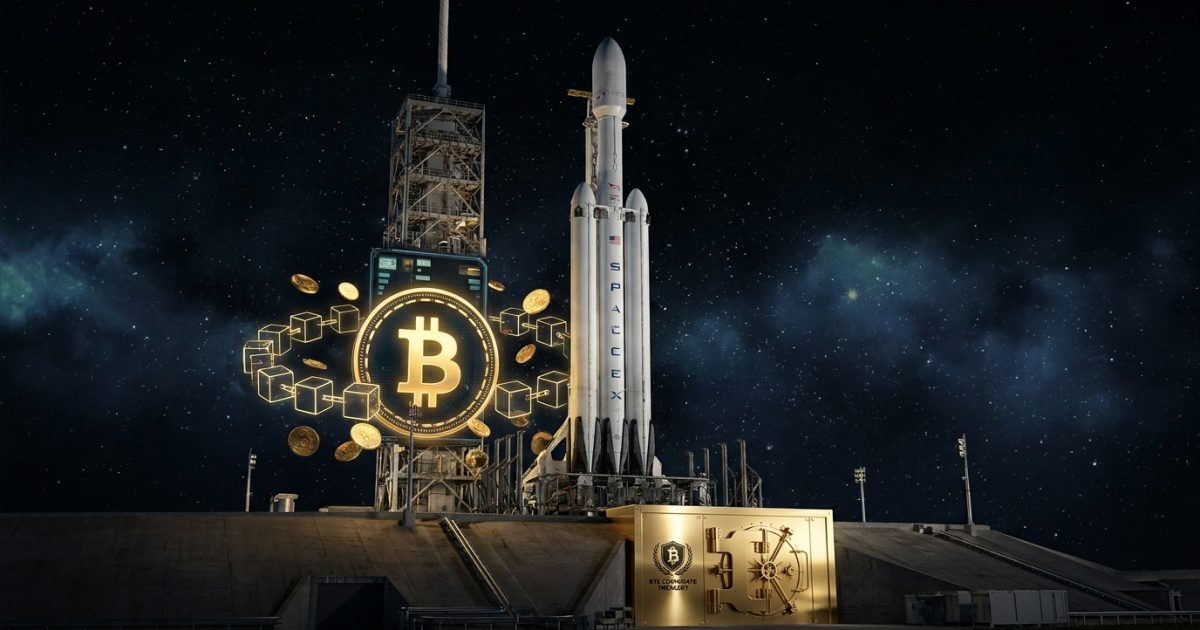
Elon Musk’s rocket and satellite company SpaceX filed its long-awaited S-1 registration statement with the U.S. Securities and Exchange Commission on May 20, 2026, and the document contained a figure that surprised even seasoned bitcoin watchers: 18,712 BTC sitting on the balance sheet, acquired at a total cost basis of roughly $661 million.
That works out to an average buy price of around $35,325 per coin – a position the company built quietly, with no public fanfare, at some point before the end of 2024. The filing confirms SpaceX hasn’t added to the position since, but neither has it sold. As of March 31, 2026, with bitcoin trading near $77,600, the stake carries a fair value of approximately $1.45 billion. By some league tables, that places SpaceX seventh among publicly traded companies by bitcoin holdings, behind Strategy (formerly MicroStrategy), Tesla, Block, Marathon Digital, Galaxy Digital, and Coinbase.
SpaceX is targeting a valuation of more than $1.5 trillion in the offering, which could rank it among the ten most valuable companies in history. The bitcoin disclosure adds a layer most traditional S-1 filings don’t carry: a digital asset treasury that, depending on price action on listing day, could move in ways entirely disconnected from rocket launches and satellite subscriptions.
What the Filing Actually Says
The S-1 describes the company’s bitcoin position as a “digital asset” on the balance sheet, recorded at fair value under current accounting rules. SpaceX adopted the Financial Accounting Standards Board’s ASU 2023-08 standard, which requires companies to mark cryptocurrency holdings to market each quarter and recognize unrealized gains and losses through net income.
That treatment means SpaceX’s reported earnings will carry bitcoin volatility directly. A 10% move in the bitcoin price translates to roughly $145 million in unrealized gain or loss hitting the income statement. For a company whose primary revenue comes from launch contracts and Starlink subscriptions, that’s a notable exposure.
The filing didn’t explain when or why SpaceX accumulated the position. Musk has been publicly supportive of bitcoin for years, but SpaceX has kept its balance sheet details closely guarded as a private company. The S-1 is the first time the full extent of those holdings has been made public.
Where It Sits in the Corporate Treasury Race
The corporate bitcoin treasury movement has accelerated sharply since 2024. Strategy holds the dominant position with well over 500,000 BTC accumulated under its aggressive acquisition strategy. Tesla, which bought and partly sold bitcoin in 2021, still carries a position. Several miners – Marathon Digital, Riot Platforms, CleanSpark – hold large amounts by default through their operations.
SpaceX’s 18,712 BTC is notable for a different reason: it was accumulated by a non-financial, non-crypto-native business. The company makes rockets. It operates the world’s largest satellite internet network. Bitcoin is a side allocation, not a core strategy, which makes the scale of the position more surprising. Prior on-chain analysis had estimated SpaceX might hold a few thousand coins at most. The actual number exceeded nearly every analyst estimate.
Coincentral noted that the cost basis implies SpaceX bought the bulk of its position when bitcoin was trading in the $30,000-$40,000 range, likely in 2023 or early 2024. At current prices, the unrealized gain stands at approximately $790 million.
Why the Timing Matters
The IPO arrives as bitcoin has returned above $77,000 after a turbulent stretch earlier in 2026 that saw the price crash below that level amid geopolitical tensions and bond market stress. SpaceX’s listing, expected in June, puts significant institutional demand behind the offering.
Markets will be watching two things simultaneously: the valuation of the core business – launch cadence, Starlink subscriber growth, Starship commercial contracts – and the implied mark-to-market on $1.45 billion in bitcoin. The latter could attract a class of investor that would never otherwise look at an aerospace IPO.
“This is a new kind of dual-asset story,” one institutional allocator told CoinDesk. “You’re buying SpaceX’s launch business and you’re implicitly long bitcoin at whatever price it trades on listing day.”
Competitive Context
If SpaceX goes public at a $1.5 trillion valuation, its bitcoin treasury represents roughly 0.1% of total market cap – a smaller proportional allocation than companies like Strategy or Tesla, where the BTC position is more central to the investment thesis. But in absolute terms, it’s still one of the largest single corporate treasury positions held by a non-crypto company, and it’ll be visible on a public balance sheet for the first time.
Other major technology companies have declined to hold bitcoin as a treasury asset. Microsoft shareholders voted against a proposal to add bitcoin to the balance sheet in late 2024. Amazon has faced similar shareholder pressure with no result. Apple and Alphabet hold no disclosed digital assets. SpaceX’s disclosure, combined with the IPO, effectively creates a new public comparator: a technology company that builds rockets and happens to carry $1.45 billion in bitcoin.
FAQ
How many bitcoin does SpaceX hold, and what are they worth? SpaceX disclosed 18,712 BTC as of March 31, 2026, acquired at a total cost basis of roughly $661 million. At the bitcoin price at the time of filing – approximately $77,600 – the position was worth around $1.45 billion.
When did SpaceX buy its bitcoin? The S-1 filing didn’t specify when SpaceX accumulated its position, but the average cost basis of roughly $35,325 per coin suggests the purchases were made primarily in 2023 or early 2024.
How does SpaceX’s bitcoin holding compare to other public companies? With 18,712 BTC, SpaceX would rank approximately seventh among publicly traded companies by bitcoin holdings, behind Strategy, Tesla, Block, Marathon Digital, Galaxy Digital, and Coinbase.
Sources: SpaceX S-1 SEC filing (May 20, 2026), CoinDesk, CoinCentral, CryptoTimes, Benzinga